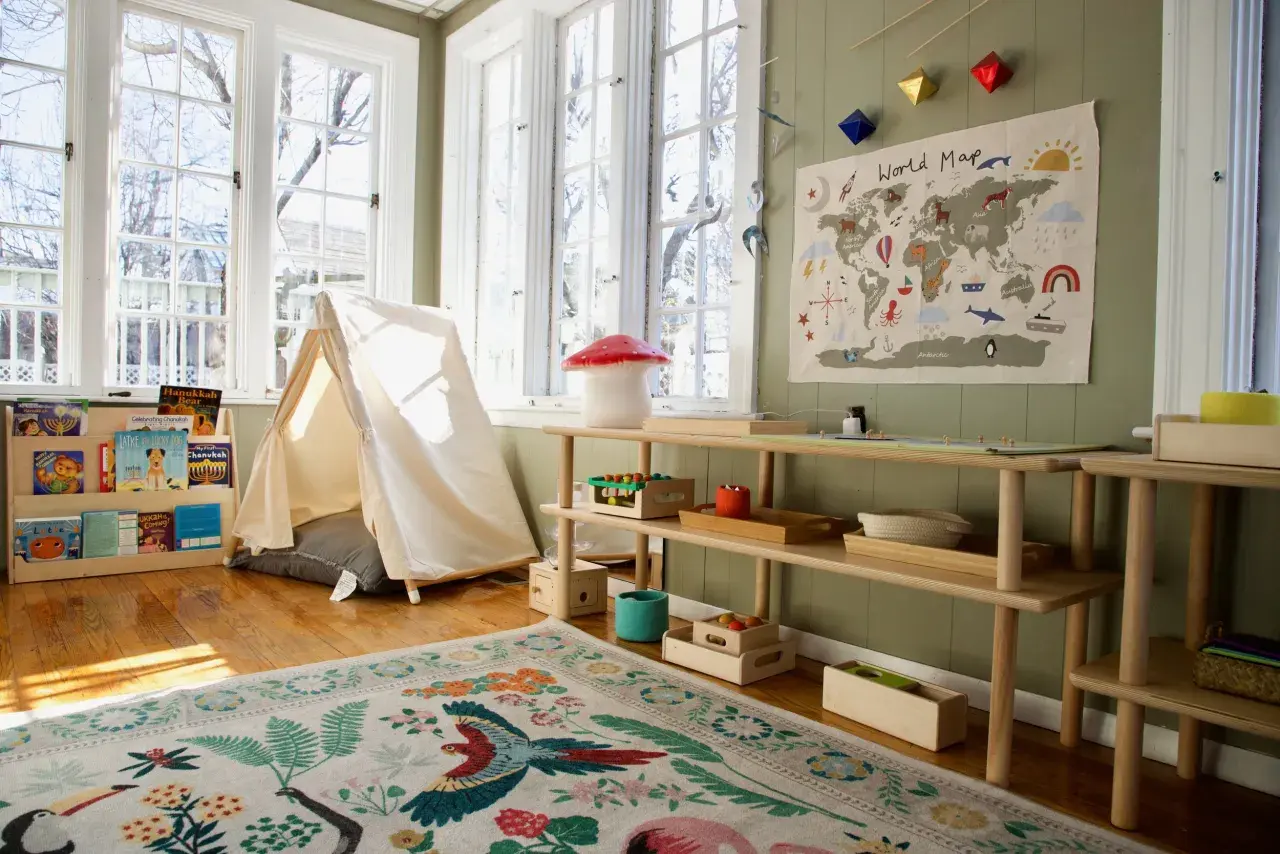
A Montessori home setup works best when the room lets a child reach, choose, use, and return things without constant adult help. For a nursery or playroom, that means thinking less about themes and more about access, order, safety, and the right amount of choice. I’m going to break down the layout, the furniture worth buying, what to put on the shelves, and the safety rules that should come first in a U.S. home.
The room should stay simple, reachable, and easy to reset
- Keep the space limited to a few clear zones: sleep, play or work, reading, and practical life.
- Use low storage and child-height access so the child can act independently.
- For babies, safe sleep comes first; Montessori styling comes after that.
- Display only a handful of toys or materials at once, then rotate the rest.
- Buy fewer, sturdier pieces instead of filling the room with decor or closed bins.
What the room should teach a child
When I design a Montessori-inspired nursery or playroom, I ask one question: can the child use the space without asking permission for every small thing? If the answer is yes, the room is doing its job. The goal is not a perfect display; it is a room that supports independence, concentration, and a calm rhythm.
That usually comes down to three principles. First, the environment should be predictable, so the child knows where things belong. Second, the materials should be functional, not just pretty, so a child can actually use them. Third, the room should leave a little breathing room. Too much visual noise makes even a good setup harder to use, especially for toddlers who are still learning self-regulation.
In practice, I want the room to say: “You can reach this, you can try this, and you can put it back when you’re done.” That one idea shapes almost every other choice, which is why the layout matters before the decor does.

How to divide the room into clear zones
A Montessori room works better when it has distinct zones instead of one open pile of toys. The child does not need a huge room; they need clear cues about what each part of the room is for. Even a small nursery can work if the zones are simple and consistent.
| Zone | What goes there | Why it works |
|---|---|---|
| Sleep zone | Crib or floor bed, simple bedding, dim light, very little visual clutter | Signals rest instead of stimulation |
| Work or play zone | Low shelf, rug or mat, small table, baskets, trays | Makes independent activity easy to start and finish |
| Reading zone | Front-facing book basket or shelf, cushion, soft light | Keeps books inviting and easy to choose |
| Practical life zone | Child broom, wiping cloth, water cup, dressing basket, simple tools | Lets the child practice real-life care tasks |
In a small space, zones can overlap. A rug can define the work area, while a book basket sits beside it. What I would avoid is scattering activity across every wall, because that makes the room feel busy even when the toy count is small. The next step is choosing furniture that supports those zones without overwhelming them.
The furniture that actually matters
I would rather buy one good shelf than three decorative storage pieces that do not help the child. The most useful furniture in a Montessori-style room is the kind that gives the child direct access and gives the parent an easy reset at the end of the day. In the U.S., a lean setup can often start around $150-$350 if you reuse what you already own, while a more polished room usually lands somewhere between $400 and $1,500 depending on furniture quality and how much needs to be purchased new.
| Item | What to look for | Typical U.S. budget |
|---|---|---|
| Low open shelf | Visible storage, stable base, easy reach, no doors to wrestle with | $40-$180 |
| Child-sized table and chair | Stable, low enough for feet to ground, wipeable surface | $60-$250 |
| Crib or floor bed | For infants, a safe sleep product; for older toddlers, a low bed only when the room is fully ready | $120-$500 |
| Rug or floor mat | Non-slip, easy to clean, clearly defines a workspace | $20-$120 |
| Hooks or open wardrobe | Placed at child height so dressing is manageable | $20-$150 |
| Mirror | Low, securely mounted, useful for self-recognition and movement work | $30-$120 |
I also like simple materials over flashy ones. Wood, cotton, wool, and matte finishes usually make the room feel calmer, but the material itself matters less than whether the item is sturdy and usable. If budget is tight, start with the shelf and the floor mat, because those two pieces change the room fastest. That leads naturally to what belongs on those shelves in the first place.
What to keep on the shelf and what to rotate out
Montessori.org gets this part right: fewer choices usually lead to better focus. In a toddler room, I usually keep only 6-8 visible activities at a time, and sometimes fewer if the child gets overstimulated easily. The point is not to display everything the child owns; it is to create a shelf that invites real engagement.
A strong shelf mix usually includes:
- One puzzle or matching activity for problem-solving.
- One building material such as blocks, stacking pieces, or magnetic shapes.
- One fine-motor task such as threading, lacing, or peg work.
- One practical-life tray, such as pouring, scooping, or wiping.
- One art option with paper, crayons, or a simple drawing tray.
- A small set of front-facing books that can be reached without help.
I also like to rotate by purpose, not by impulse. If a child keeps going back to the same wooden blocks and ignores the puzzle for two weeks, I do not add more toys; I swap the puzzle out and see whether a different challenge fits better. That keeps the shelf fresh without turning the room into a toy warehouse. Once the materials are under control, the next priority is making sure the space is safe enough for independent use.
Safety decisions that should come before aesthetics
For nurseries, safety is not a side issue. The American Academy of Pediatrics recommends room-sharing without bed-sharing for at least the first 6 months, and preferably up to 1 year. That matters because a beautiful room is not Montessori if it ignores sleep safety. For infants, I would treat the sleep space as non-negotiable and design the rest of the room around it.
- Use a crib, bassinet, portable crib, or play yard that meets current safety standards.
- Keep the sleep space empty: no pillows, quilts, bumpers, or stuffed toys.
- Lower the crib mattress as soon as the child becomes more mobile and can pull up.
- Anchor shelves, dressers, and bookcases to the wall.
- Hide cords, blind strings, and unstable lamps.
- Keep small parts and choking hazards off low shelves until the child is developmentally ready.
- Use a floor bed only when the child is ready for that level of freedom and the room has been fully babyproofed.
That last point matters more than many parents expect. A floor bed can be a strong Montessori choice for some toddlers, but it is not a shortcut for infant sleep or for a room that still has unsafe edges, loose cords, or climbable furniture. Safety is the framework, and the Montessori layer sits on top of it. With that in place, age-specific adjustments become much easier.
How I would adapt the setup by age
The same room should not look identical at every stage. A good setup changes with the child, and that is part of the method. I think of it as matching the room to the child’s current abilities instead of forcing a permanent design.
| Age | Main focus | What to include | What to avoid |
|---|---|---|---|
| 0-6 months | Safe sleep and gentle sensory input | Crib or bassinet, tummy-time mat, one mirror, a few high-contrast books | Loose bedding, floor bed, crowded shelves, too many toys |
| 6-18 months | Reaching, grasping, pulling up, cause and effect | Low mirror, soft mat, one shelf with a few baskets, simple sensory objects | Heavy decor, exposed small pieces, overstuffed bins |
| 18 months-3 years | Independence and repetition | Low shelf, child table, practical-life tray, dressing basket, simple art materials | Too many duplicates, deep closed storage, cluttered displays |
| 3-6 years | Concentration and responsibility | Puzzles, handwork, art station, books, small tools for cleaning and helping | Babyish toys that no longer fit the child’s abilities |
What I would build first if I were starting from scratch
When I start from zero, I do not buy the cute extras first. I build the room in layers so the money goes where the child will feel it every day.
- First, I would anchor the sleep setup and clear the room of anything unsafe or visually noisy.
- Second, I would add one low open shelf and keep only a few activities visible.
- Third, I would place a rug or mat to define the work area.
- Fourth, I would add hooks, a basket, or a small wardrobe section at child height.
- Fifth, I would leave room to rotate toys instead of buying more immediately.
That is usually enough to create a room that feels calm, functional, and genuinely child-centered. A basic reset can stay around $150-$350, a balanced room often lands around $400-$900, and a full refresh can move into the $1,000-$2,500 range if you are buying new furniture and finishing the space from scratch. The smartest version is rarely the most expensive one; it is the one the child can use independently every day.
