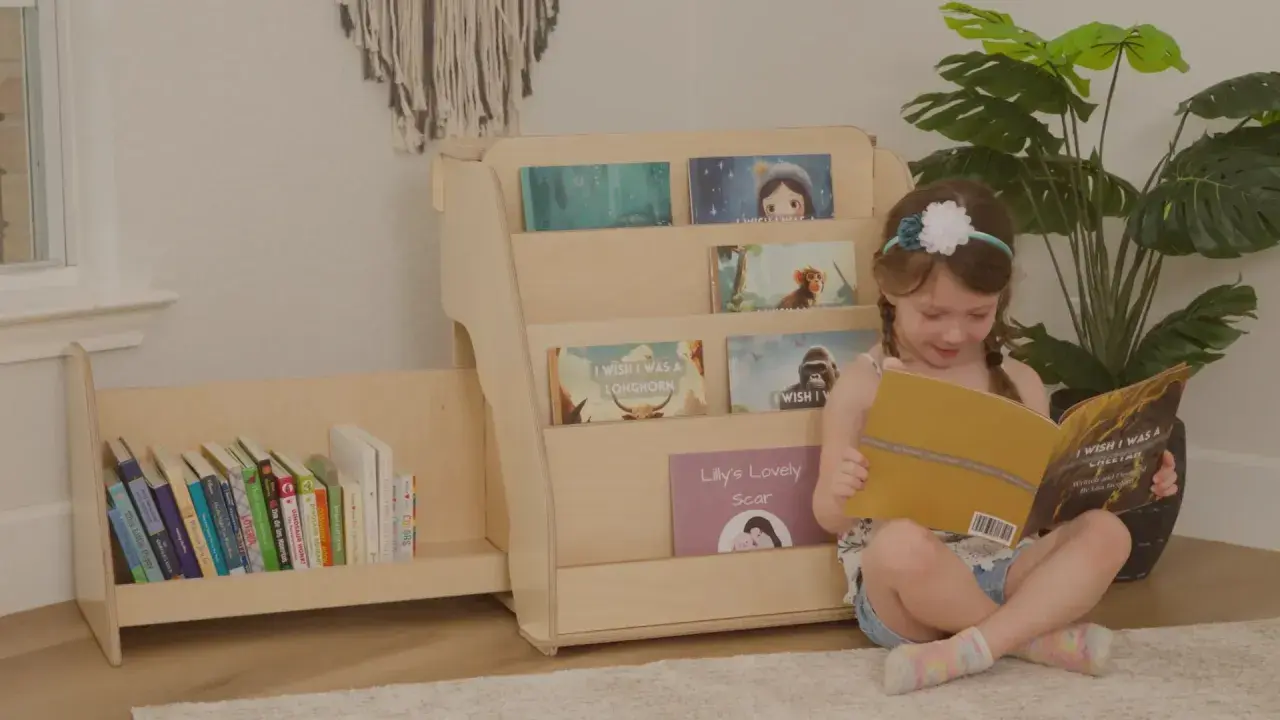
The essentials at a glance
- Keep it low and open. The shelf should invite self-selection, not hide books behind doors or bins.
- Show the covers. Front-facing display space makes it easier for young children to choose a book.
- Anchor every freestanding unit. A stable shelf is still a shelf that can tip if a child climbs it.
- Build for rotation. Fewer visible books, swapped regularly, work better than a crowded display.
- Use child-safe finishes. Low-VOC paint or a fully cured water-based finish is the practical nursery choice.
What a Montessori bookshelf really needs to do
The American Montessori Society describes Montessori environments as using open shelves with materials that children can reach on their own, and that principle matters more than any single style of furniture. A good bookshelf does three jobs at once: it keeps books visible, keeps them reachable, and makes putting them back feel obvious. I think that is the real test. If a child can choose a book without asking for help, and return it without turning the room upside down, the shelf is doing its job.
That is why a front-facing display often works better than a deep traditional bookcase in a nursery or playroom. Spines hide choices; covers invite them. And when the room is calm, the shelf becomes part of the routine instead of another thing adults have to manage. Once the purpose is clear, the next step is choosing the right format for your space.
Choose the format that fits your room
| Format | Best for | Strengths | Tradeoffs |
|---|---|---|---|
| Floor-standing front-facing shelf | Nurseries and toddler playrooms | Easy for children to use, simple to build, visually clean | Must be anchored and sized carefully |
| Wall-mounted book ledge | Small rooms and tight corners | Uses very little floor space, good for a few rotating books | Less storage, requires solid wall mounting |
| Cube shelf conversion | Families who already own a cube unit | Fastest path, budget-friendly if repurposed | Usually bulkier and less elegant than a purpose-built shelf |
| Hybrid shelf with a lower basket | Playrooms with mixed books and toys | Works well when you want books and a small toy rotation in one zone | Easy to overfill if you do not edit the contents |
I usually recommend a floor-standing design for most homes because it balances independence, stability, and flexibility. A wall ledge is excellent when floor space is limited, but it needs stricter installation. Once you pick the format, the build becomes mostly a question of proportions and materials.
Materials and dimensions that actually work
For a basic build in the United States, I would budget roughly $60 to $150 in materials, depending on lumber choice, paint, and hardware. That estimate assumes you already own the tools. A cleaner finish, hardwood plywood, or a nicer face frame can push the cost higher, but a useful Montessori shelf does not need to be expensive.
| Element | Practical recommendation | Why it matters |
|---|---|---|
| Overall height | 24 to 30 inches for toddlers, 30 to 36 inches for preschoolers | Low enough for independent access without encouraging climbing |
| Overall depth | 10 to 12 inches | Keeps the unit stable while still allowing picture books to fit |
| Front lip or ledge | 1.5 to 2 inches | Helps books stay upright without hiding too much cover art |
| Shelf spacing | 8 to 10 inches for board books, 10 to 12 inches for mixed sizes | Prevents overcrowding and makes each title easier to remove |
| Material thickness | 3/4-inch plywood or solid boards | Adds rigidity and reduces wobble over time |
| Finish | Low-VOC paint, water-based polyurethane, or hardwax oil | More nursery-friendly once fully cured and aired out |
When I build for a nursery, I keep the top edge low enough that a standing child can see and reach it without stretching. For a playroom, I sometimes go a little taller, but I never let the shelf become a mini bookcase that a child has to climb to use. After the dimensions are set, the actual assembly is straightforward.

Build it step by step
I like the simplest version of this project: a low, sturdy shelf with a shallow front display and a smooth finish. If you want a practical starter size, aim for about 30 inches wide, 28 inches high, and 12 inches deep. That is a comfortable footprint for board books and picture books without dominating the room.
1. Plan the footprint
Mark the shelf size on the floor with painter’s tape first. This sounds minor, but it prevents the most common mistake: building something that looks small in a garage and bulky in a nursery. Slide a few books into the taped outline and check reach height before you cut anything.
2. Cut the panels
Use 3/4-inch plywood or solid boards for the sides, top, base, and shelves. If you are building with plywood, a circular saw with a guide or a track saw keeps the cuts cleaner. Pre-drill every screw location so the wood does not split, especially near the edges.
3. Assemble the frame
Join the sides to the top and bottom first, then add the interior shelves. Wood glue plus screws is enough for a simple build. Pocket screws are nice if you already use them, but they are not required. What matters is that the unit feels rigid before you add the finish.
4. Add the front display
This is the detail that makes the piece feel Montessori instead of generic. Add a shallow lip, book rail, or ledge across each shelf so covers face outward. Keep that front edge low enough that the cover still shows clearly. Too tall, and the shelf starts hiding the book again.
5. Sand and finish
Round over sharp corners, sand the face edges smooth, and wipe away dust before finishing. I prefer a low-sheen finish because it looks calmer in a nursery and hides fingerprints better than a glossy coat. If you paint it, let it cure fully before loading it with books.
Read Also: Montessori Bathroom- Create an Independent Child's Space
6. Anchor it before use
Freestanding furniture in a child’s room should not be treated as self-stable just because it is short. CPSC’s Anchor It campaign exists for a reason: bookcases and shelving can tip if a child climbs or pulls on them. Secure the shelf to wall studs with proper anti-tip hardware before the first book goes in.
At this point the structure is finished. The last step is making it fit the room so it feels intentional rather than simply placed there, and that is where nursery and playroom decisions start to matter.
Place and style it so children actually use it
For a nursery, I keep the shelf quiet and selective. Four to six board books is enough for a baby or young toddler, especially if the rest of the room already has a lot of visual input. A small woven basket beside the shelf can hold cloth books or a rotating seasonal title without crowding the display.
For a playroom, I usually stretch that to six to ten books, plus one small basket if there is room. The key is to leave visible breathing space. A shelf that is too full stops feeling inviting, and children are less likely to tidy it if they cannot see where things belong. The American Montessori Society’s guidance on open, reachable shelves aligns with that practical reality: the room works better when the child can recognize order at a glance.
I also place the shelf where a child naturally pauses, not in a dead corner. Near a rug, a reading chair, or a soft mat is better than beside a busy doorway. If the shelf is part of a small reading zone, it becomes a routine stop instead of background furniture. Once that routine is in place, the next challenge is avoiding the mistakes that quietly ruin the result.
Avoid the mistakes that make the shelf harder to use
- Making it too tall. If a child has to stretch or climb to reach the top shelf, the design has already lost part of its Montessori value.
- Using closed storage. Doors and deep bins hide the covers and make self-selection harder.
- Overloading the display. Too many books look impressive to adults and overwhelming to children.
- Skipping anchoring. A short shelf can still tip if someone uses it like a ladder or tug point.
- Choosing a slippery finish. Very glossy surfaces tend to show wear and feel less calm in a nursery.
- Ignoring the room around it. If toys, baskets, and furniture crowd the shelf, children lose the open floor space they need to sit and browse.
The small details matter more than the decorative ones. A shelf that is accessible, stable, and easy to reset will be used constantly; a shelf that looks stylish but is awkward to approach will quietly become adult-managed storage. If you want the piece to stay useful as your child grows, design for change from the start.
Let the shelf grow with your child instead of replacing it
I prefer shelves that can change roles without a full rebuild. A toddler shelf can become a preschool reading display, then later shift into a place for early readers, art books, puzzles, or a small writing tray. Adjustable shelves help, but even a fixed unit can stay useful if the footprint is simple and the finish is neutral.
If I were building one shelf for the long haul, I would choose a sturdy box, keep the front display shallow, and make the interior open enough to accept different book sizes over time. That approach keeps the project practical instead of overdesigned, and it means the furniture still earns its place after the nursery years are over. The best Montessori pieces are rarely the fanciest ones; they are the ones children can use every day without thinking about the furniture at all.
