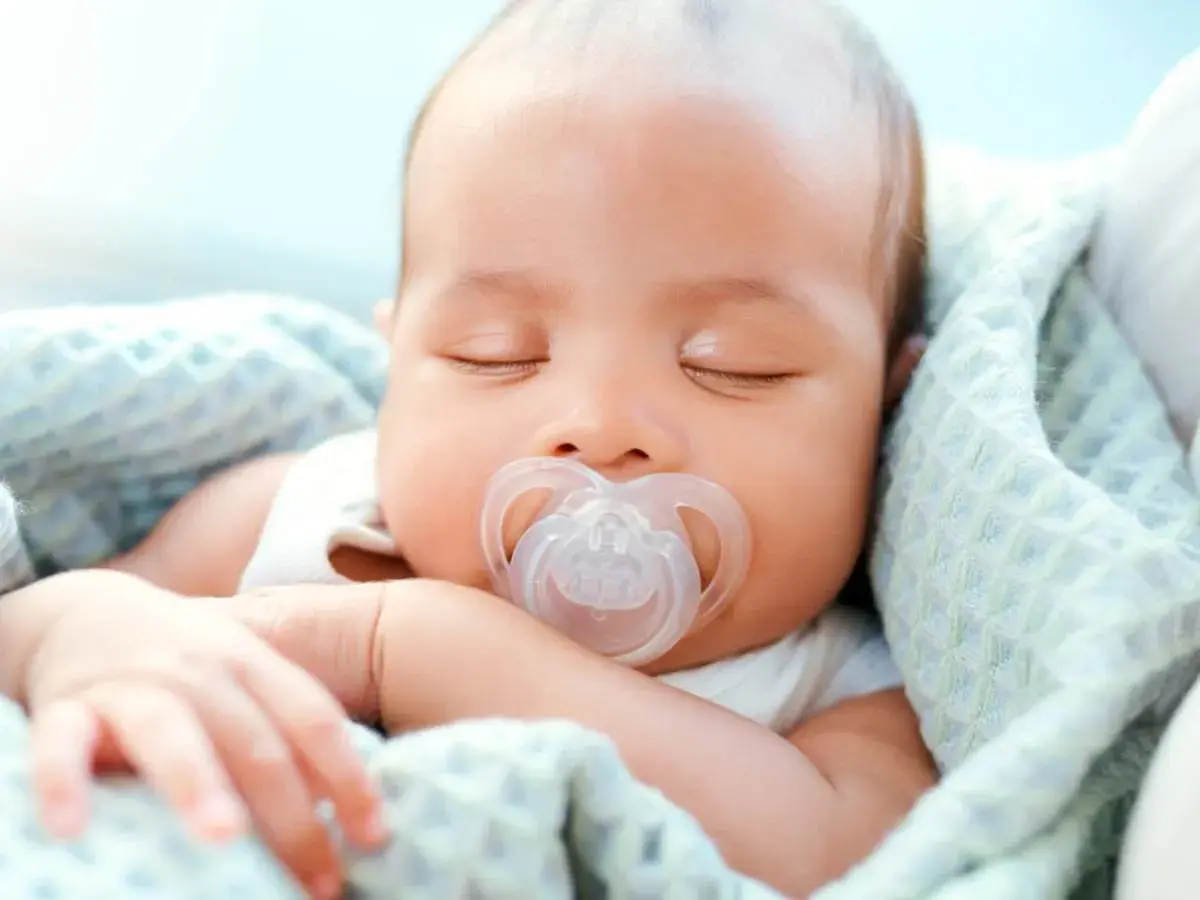
I treat pacifiers as a useful tool, not a default, because timing matters more than the object itself. For a healthy newborn, the real question is not just whether a pacifier can be used, but whether it fits the feeding plan, sleep routine, and safety rules in those first fragile weeks. This guide gives you the practical answer, the breastfeeding trade-offs, and the safety details that matter most in a U.S. nursery.
The quick take before you offer one
- Healthy term newborns can use a pacifier, but breastfeeding babies usually do better if you wait until feeding is clearly established.
- Pacifiers are most useful at nap time and bedtime, not as the first fix for every cry.
- A pacifier should never replace a feeding, especially in the early days when hunger cues can be subtle.
- Choose a one-piece pacifier, keep it clean, and never attach it to strings, cords, clips, or stuffed toys during sleep.
- If your baby keeps rejecting the pacifier, I would not force it. Rejection often means the baby needs something else.
Do newborns use pacifiers safely
For a healthy term newborn, the answer is usually yes. The key is not whether pacifiers are “allowed,” but when they make sense. In my view, they are a comfort tool with guardrails: useful for soothing and sleep, but never a substitute for a feed or for safe sleep habits.
For formula-fed babies, the timing is flexible. For breastfed babies, I prefer to wait until feeding is going well and weight gain is on track. That often means waiting about 3 to 4 weeks. That timing lines up with current AAP and CDC guidance, which support pacifier use at nap time and bedtime while suggesting breastfeeding families wait until feeding is well established.| Feeding situation | Practical approach | Why it matters |
|---|---|---|
| Formula-fed healthy newborn | A pacifier can usually be offered early if the baby is otherwise settled | There is no breastfeeding establishment window to protect |
| Breastfed healthy newborn | Wait until latch, milk transfer, and weight gain are clearly going well | Early pacifier use can make it harder to read hunger cues and feeding rhythm |
| Preterm or medically fragile newborn | Ask the pediatric team first | Feeding, breathing, and calming needs can be very different |
When to introduce one in the first month
The first few weeks are when a pacifier can help most and confuse things most. I like to think in terms of three checkpoints: Is the baby feeding effectively? Is the baby gaining weight as expected? Does the baby still seem hungry after a full feeding? If any of those answers is uncertain, I would hold off.
- Offer the pacifier after a feed, not before.
- Use it mainly for sleep or short soothing periods.
- Skip it if your baby is still learning to latch or seems too sleepy to feed well.
- Do not use it to stretch time between meals in the newborn period.
Parents often discover that what looks like fussiness is actually an early feeding cue. A baby who is rooting, opening the mouth, or sucking on hands soon after a feed may not need a pacifier at all. That is why I treat the first month as a feeding-first phase, with the pacifier in a supporting role, not a starring one.
Why pacifiers often help at nap time and bedtime
The strongest reason to use a pacifier in early infancy is sleep-related. Pacifier use at nap time and bedtime is associated with a lower risk of SIDS, and that benefit is most meaningful when it sits inside the bigger safe-sleep picture: back sleeping, a firm surface, an empty crib, and no bed-sharing. A pacifier is helpful, but it is not a shortcut around the basics.
- If the pacifier falls out after your baby is asleep, you do not have to put it back in.
- If your baby refuses it, I would not force it into the routine.
- If the only way your baby settles is with a pacifier every few minutes, the bedtime routine may be too dependent on one cue.
That last point matters more than many parents expect. A pacifier can soothe, but it should not become the only tool you reach for when the real issue might be hunger, overtiredness, or the need for a different calming technique. Which is why the details of safe use matter just as much as the decision to use one.

How to choose and clean a pacifier that belongs in the nursery
I care about pacifier safety in the same way I care about crib safety: the details are plain, but they are the whole point. Choose a one-piece pacifier with a firm shield and ventilation holes. Skip anything that can break apart, trap moisture, or look cute but adds an attachment that should never be in a sleep space.
| Do | Don't |
|---|---|
| Pick a one-piece design with an age-appropriate shield | Use a two-piece pacifier that can separate |
| Clean or sanitize before first use and often in early infancy | Rinse it in your own mouth or keep reusing a dirty one |
| Replace it if it cracks, sticks, tears, or looks worn | Assume a pacifier is fine just because it still “looks okay” |
| Store it in a clean place between uses | Attach it to strings, cords, blankets, or stuffed toys for sleep |
Cleaning is especially important in the early months, when babies have less immune protection and everything ends up in the mouth. If you keep the pacifier simple, clean, and separate from sleep accessories, you remove most of the avoidable risk. After that, the bigger question becomes whether the baby is actually asking for comfort or for food.
When the pacifier is hiding hunger or another problem
This is the part I watch most closely. A pacifier should calm a baby who is already fed, not distract you from a baby who is trying to tell you something important. If the crying starts soon after a feeding, I would check for hunger cues, a weak latch, gas, a too-hot or too-cold room, or general discomfort before reaching for the pacifier again.
- Rooting, lip-smacking, or hand-sucking right after a feed.
- Short, frustrated feeds followed by continued crying.
- Poor weight gain or a baby who seems too sleepy to feed effectively.
- Fewer wet diapers than you would expect for your baby’s age.
- Crying that does not improve with feeding, holding, or a diaper change.
If any of that is happening, I would pause the pacifier plan and look at feeding first. That is especially true in the newborn stage, when tiny feeding problems can look like simple fussiness. A pacifier can soothe the surface; it cannot fix the reason underneath.
The rule I use for the first weeks at home
My practical rule is straightforward: feed first, soothe second, sleep safely always. For a breastfed newborn, I would usually wait until feeding is established before introducing a pacifier. For a formula-fed newborn, the timing is more flexible, but I would still use it mainly for sleep and brief soothing, not as a way to postpone meals.
If the baby accepts it and settles, fine. If the baby rejects it, fine. If the pacifier starts to feel like it runs the house, I would step back and re-check the feeding pattern, sleep setup, and daily rhythm. Used with restraint, it can be a small nursery helper. Used as a substitute for reading your baby, it becomes noise without much benefit.
That is the practical answer I would trust: pacifiers can be part of newborn care, but the best results come when they are introduced with timing, safety, and feeding needs in mind.
