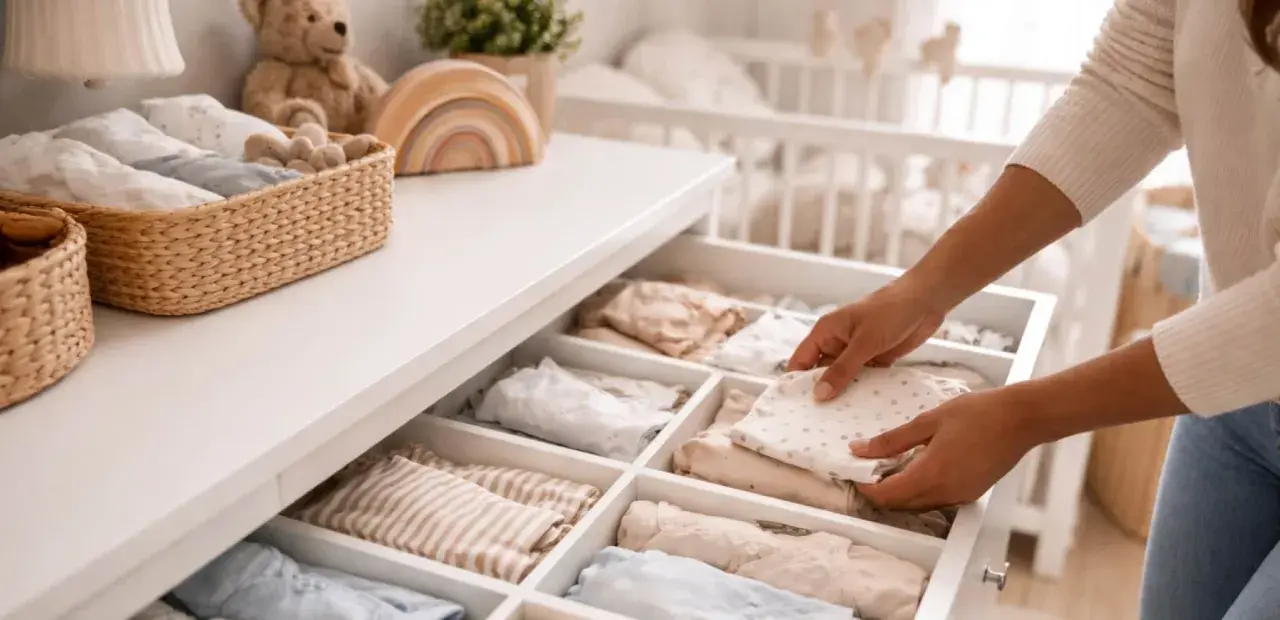
Knowing how to organize baby clothes makes everyday care easier in a way that looks small on paper and huge at 2 a.m. The goal is not a picture-perfect nursery; it is a simple system that keeps current outfits easy to grab, next sizes visible, and outgrown pieces out of the way. When I set it up well, the whole room feels calmer because I am not digging through tiny socks, mystery piles, and half-folded sleepers.
What matters most when the nursery drawers need to work fast
- Sort clothes by current fit first, then by season and type.
- Keep only the sizes your baby actually wears in daily reach.
- Use drawer dividers, bins, or labels so tiny items do not blur together.
- Store the next size up in one clearly marked place, not all over the room.
- Move outgrown clothes out of the active wardrobe before the drawer overflows.
- Keep the system simple enough that laundry day does not undo it.
Sort by fit first, not by what looks cute on the hanger
I always start with a full sort, because the fastest way to lose control is to fold everything before deciding what actually belongs in the nursery. Baby sizing is inconsistent across brands, so I sort by the label first and then sanity-check the fit. A piece labeled 3-6 months might fit like a dream or be nearly skipped entirely, depending on the cut.
| Pile | What goes in it | Why I use it |
|---|---|---|
| Current size | Clothes that fit right now and will likely fit through the next laundry cycle | This is the only pile that should live in the easiest-to-reach space |
| Next size up | Items the baby is close to wearing, but not yet | It keeps growth transitions smooth instead of messy |
| Seasonal hold | Items that are the right size but wrong for the weather | It prevents a winter drawer from being packed with summer rompers |
| Outgrown | Anything too small, worn out, stained, or no longer needed | It gets clutter out of the active wardrobe immediately |
For most families, this first pass is the moment that makes the rest of the system obvious. Once the piles are separated, the next decision is where each group should live without crowding the nursery.

Choose a storage system that fits your nursery
I do not think there is one perfect setup for every room. The best storage depends on how much space you have, how often you do laundry, and whether the nursery is the only place you can keep baby gear. In a small room, a dresser with a few well-planned drawers is often enough. In a room with closet space, I like a mix of hanging storage for outfits and bins for overflow.
| Storage option | Best for | Strength | Watch out for |
|---|---|---|---|
| Dresser drawers | Daily basics like bodysuits, sleepers, pants, and sleepwear | Fast access and easy folding | Drawers get chaotic if you skip dividers or overfill them |
| Closet rods and shelves | Outfits, dresses, jackets, special-occasion pieces | Keeps coordinated sets visible | Small items can disappear if everything is hung |
| Lidded bins | Next sizes, seasonal clothes, hand-me-downs, long-term storage | Stacks well and labels clearly | Not ideal for things you need every day |
| Open baskets | Frequently used extras like bibs, hats, mittens, and socks | Easy to drop items into in a hurry | Can look neat only if you keep categories simple |
My rule is simple: open storage for active items, closed storage for overflow. That one decision prevents the nursery from feeling busy all the time. If the room is tight, a few bins in a playroom closet or on a high shelf can handle the next sizes without stealing valuable drawer space.
Make the everyday drawer layout simple enough to maintain
I prefer file-folding for baby clothes because it lets me see every item at once. That matters more than perfect-looking stacks, especially when the baby is crying and I want the right sleeper in seconds. File-folding means folding clothes into small rectangles and standing them upright like files in a drawer, which keeps the front edge visible instead of hiding half the drawer under a pile.
For a typical nursery dresser, I like a layout like this:
- One drawer for bodysuits and tees.
- One drawer for sleepers and pajamas.
- One drawer for pants, leggings, and shorts.
- A small tray or divider section for socks, mittens, bibs, and hats.
If you only have two usable drawers, combine categories instead of forcing a more complex system. I would rather have one reliable drawer for daily clothes than four drawers that no one can keep straight. Drawer dividers help here, but only if they support the real routine; if they create more sorting than the laundry itself, they are too fussy.
For tiny items, I also like a simple rule: keep one category per compartment. Socks do not need to share a space with burp cloths, and hats should not drift into the sleeper pile. That small separation makes the drawer usable long after the initial organizing session is over.
Once the active drawers are clean and readable, the remaining job is keeping outgrown items from sneaking back into them.
Put outgrown clothes somewhere they cannot leak back into the drawer
Outgrown clothes are the hidden reason baby storage falls apart. A shirt that no longer fits has a way of lingering in the nursery because it feels easier to set it aside than to process it properly. I have found it works much better to move those items out immediately and give them their own labeled home.
| Action | Why it matters |
|---|---|
| Wash and dry before storing | It protects the fabric and helps prevent odors or mildew |
| Label by size and season | It saves time when you need to retrieve the right bin later |
| Keep only worth-saving items | It avoids storing stained, stretched, or duplicate pieces |
| Store in a cool, dry place | It helps the clothes stay in usable condition |
If you plan to save clothing for another baby, I would be selective. Keep the pieces that wear well, wash well, and make sense for your climate and lifestyle. Specialty outfits are rarely worth long-term storage unless they have real sentimental value. The rest can be donated, passed along, or recycled instead of taking up shelf space for years.
This is also the point where a lot of people overcomplicate things. They make separate bins for every tiny size gap, then spend more time remembering the system than using it. One bin per major size range is usually enough.
Avoid the habits that make baby wardrobes messy again
The biggest mistakes are usually not dramatic. They are small habits that quietly undo the system:
- Keeping too many sizes in the active drawer.
- Mixing current clothes with hand-me-downs and future sizes.
- Using one giant bin for everything and hoping memory will do the rest.
- Skipping labels, especially for storage in a closet or playroom.
- Storing damp clothes, which is the fastest way to create a musty problem.
- Overbuying newborn pieces that the baby may barely wear.
I also think it helps to be realistic about quantity. A baby wardrobe does not need to look fully stocked all the time to be functional. In fact, a leaner active wardrobe often works better because laundry, folding, and refilling drawers stay manageable. If it takes more than a few seconds to find a sleeper or onesie, the setup is too crowded.
The good news is that the system only needs light maintenance once it is set up correctly. That brings me to the part that keeps the whole thing from slipping.
The 10-minute reset that keeps everything usable
I like a short reset every four to six weeks, or sooner after a growth spurt. It is easier to maintain a good system than to rebuild a broken one, and baby clothes change so fast that waiting too long almost always creates extra work. My reset usually happens after laundry, when the pile of clean clothes is already in front of me.
- Put current-size clothes back into the active drawer first.
- Move anything snug, short, or clearly outgrown into the outgrown bin.
- Top up the next-size bin if the baby is getting close to a size jump.
- Pull seasonal pieces forward only when the weather actually supports them.
- Check labels and replace any that are hard to read.
That is usually enough to keep the nursery working like a useful room instead of a storage trap. My preference is always for a system that survives tired mornings, rushed outfit changes, and the constant turnover of infant sizing. If the clothes are easy to see, easy to reach, and easy to rotate, the whole routine becomes much lighter.
