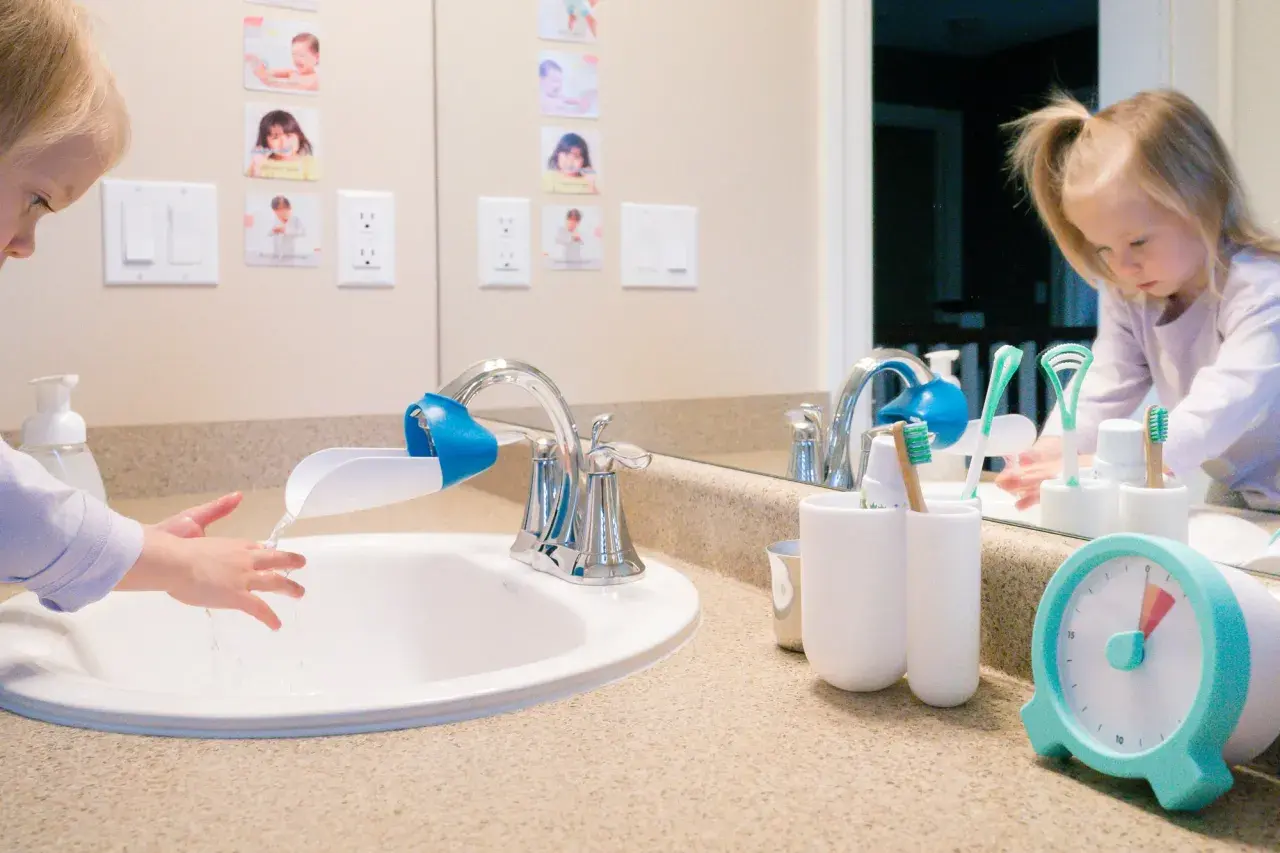
A Montessori bathroom is less about décor and more about whether a young child can participate in everyday care without constant adult lifting. I focus on reach, stability, clarity, and safety, because those are the details that let handwashing, toileting, and cleanup become repeatable skills instead of daily struggles. For nursery and playroom families, that matters early, because the bathroom is one of the first places where independence can become visible in a practical way.
What matters most when making the bathroom child-friendly
- Accessibility comes first: the sink, towel, soap, and toilet should be usable at a child’s height.
- Stability matters more than style: a solid step stool and non-slip surfaces do more than cute accessories.
- Toileting can take different forms: a small potty, toilet reducer, or full toilet setup can all work.
- Storage should be obvious: spare clothes, wipes, and hand items need a low, simple home.
- Safety stays non-negotiable: medicines, cleaners, and hot water still need adult control.
What a Montessori bathroom really is
In practice, I think of this room as a small self-care station. The child should be able to wash hands, get on or off the toilet, find a towel, and help reset the space with as little adult intervention as possible. That does not mean perfection, and it does not mean independence has to arrive all at once. It means the environment is arranged so the child can succeed repeatedly, which is the part that actually builds confidence.
The best setups usually support three simple jobs: reaching, handling, and returning things to their place. If a child can reach the soap but not the towel, or sit on the toilet but cannot manage pants, the room still depends too much on the adult. I like to treat those gaps as design problems, not behavior problems. Once the room is built around the child’s body, the routine becomes much easier to repeat. That naturally leads to layout, because the room only works if the child can physically use it.

The layout that makes independence possible
The most useful Montessori-style bathrooms are usually simple. You do not need a full remodel to make a real difference, and in most U.S. homes I would start with portable, stable pieces before changing plumbing or cabinetry. If you only change a few things, make them the ones that remove the biggest friction.
| Bathroom element | What to look for | Why it matters | Typical U.S. budget |
|---|---|---|---|
| Step stool | Wide top, non-slip feet, easy to wipe clean | Helps with sink access and toilet climbing | $15-$40 |
| Toilet reducer or child seat | Secure fit and a shape the child does not fear | Makes the main toilet feel manageable | $20-$60 |
| Small potty | Stable base and easy emptying | Useful for early toilet learning and low-footed sitting | $15-$35 |
| Low storage | Basket, open shelf, or bin at child height | Keeps underwear, wipes, and brush visible and reachable | $10-$50 |
| Non-slip floor support | Mat or textured surface near water zones | Reduces slips when hands and feet are wet | $10-$30 |
If I had to prioritize only one upgrade, I would start with a sturdy stool. It improves sink access, toilet access, and hand-drying in one move. After that, I would add low storage so the child can participate in the sequence instead of asking for every single item. A bathroom does not have to be large to work; it just has to be arranged with intention. Once the room can be used, the next question is which toileting setup fits your child best.
Choosing the right toileting setup
There is no single correct toileting setup, and that is where many parents overthink it. The right choice depends on readiness, balance, room size, and how much help your child still needs with clothing and transitions. I think the simplest way to decide is to match the setup to the child’s actual motor skills, not the age printed on a chart.
| Option | Best for | Strengths | Tradeoffs |
|---|---|---|---|
| Small potty in the bathroom | Children who need feet on the floor and quick access | Clear, familiar, and low to the ground | Must be cleaned and emptied regularly |
| Toilet reducer with stool | Toddlers and preschoolers ready to transition to the main toilet | Builds a long-term habit around the family bathroom | Can feel high or intimidating without stable footing |
| Full-size toilet with foot support | Older preschoolers who already manage climbing well | Simplifies the routine if the child is steady and confident | Usually too large to feel comfortable on its own |
For many children, the small potty is the easiest starting point because it removes the fear of falling and keeps the feet planted. For others, the reducer works better because they want to use the same toilet as everyone else. I also pay attention to clothing here: elastic waistbands and simple pull-ups matter more than parents expect, because a child cannot be independent if the outfit turns every bathroom visit into a negotiation. The better the toileting setup fits the child, the easier it is to turn the routine into something they can repeat on their own.
Simple routines that turn washing up into a habit
Montessori work depends on repetition, so I like bathroom routines that always look roughly the same. The child should know what comes next without needing a long explanation every time. When the sequence is predictable, the room feels calm, and the child can focus on the task instead of on remembering steps.
- Climb up safely with the stool or use the potty with feet supported.
- Use the toilet or potty without rushing the child through the steps.
- Wipe, flush, and pull clothing back into place.
- Wash hands with soap that the child can actually reach.
- Dry hands on a low towel and return the stool to its spot.
I like to keep a small basket nearby with backup underwear, wipes, and a spare cloth for quick cleanups. If the child spills water, they can help wipe it. If clothing gets wet, they can learn where wet items go. That is the real value here: the bathroom becomes a place where the child practices care of self and care of the environment at the same time. Once the routine is simple enough to repeat, the room needs one more thing to work well: safe boundaries.
Safety and hygiene without blocking access
Accessibility does not mean leaving hazards out in the open. In fact, the safest child-friendly bathrooms are usually the ones with clear, predictable limits. I want the child to enter the room freely, but I still want medicines, razors, bleach, and sharp items locked away or stored well above reach. Independence is the goal; uncontrolled access is not.
- Use a stable stool that does not wobble or slide on tile.
- Keep cleaners, medications, and grooming tools out of reach.
- Test water temperature before a child uses the sink.
- Use a non-slip mat or dry path near the sink and toilet.
- Keep the floor clear so the child does not step around clutter.
- Supervise younger children closely, especially during toilet learning or when the floor is wet.
I also avoid making the bathroom look like a forbidden zone unless there is a real hazard that cannot be controlled another way. Children learn through access and repetition, not mystery. If the room feels tense or overly restricted, they often treat it like a place to rush through or test boundaries in. A calm, safe space makes the next section much easier to fix, because the most common mistakes are usually design mistakes, not discipline problems.
Common mistakes that quietly undermine independence
Most bathrooms do not fail because the parent chose the wrong philosophy. They fail because the setup looks neat to an adult but still feels awkward to a child. I see the same problems again and again, and they are usually easy to correct once you notice them.
- The stool is too light or too narrow. If it shifts under small feet, the child will not trust it.
- The soap and towel are not in the same zone. A child can wash hands and still need an adult to finish the job.
- Too many items sit on the counter. Visual clutter makes the room harder to navigate and harder to clean.
- Spare clothes live in another room. If cleanup takes a trip across the house, the child loses the connection to the routine.
- The setup changes every few days. Consistency matters more than novelty when you are building a habit.
- The room is over-decorated. Cute details are fine, but they should never get in the way of function.
What I would start with this week
If I were setting up a child-friendly bathroom from scratch, I would begin with the smallest changes that create the biggest daily payoff. First, I would add a solid step stool. Second, I would place soap, a towel, and a simple storage basket where a child can reach them. Third, I would choose one toileting path and keep it consistent long enough for the child to learn the rhythm. That combination usually costs far less than a remodel, but it changes the room in a much more meaningful way.
The real win is not that the bathroom looks Montessori-inspired. It is that the child can walk in, use the space, and leave having practiced a complete self-care routine. That is what makes the room feel truly finished: not the décor, but the fact that it now works at child height.
