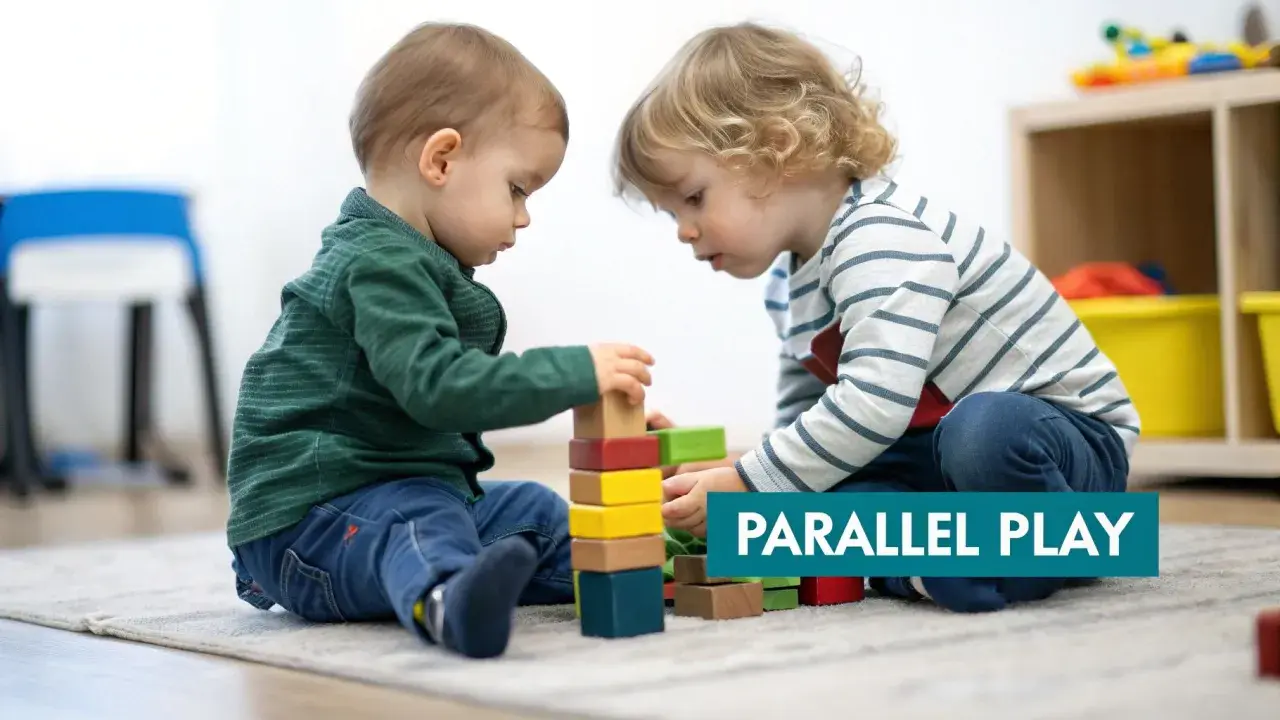
What side-by-side play gives children before they start working together
- It gives children a low-pressure way to notice other kids, copy ideas, and stay comfortable near peers.
- It supports early social skills such as turn awareness, boundary setting, and reading what another child is doing.
- It helps language grow because children hear more words, even when they are not directly chatting.
- It builds confidence and self-regulation by letting children practice being independent in a shared space.
- It works best with duplicate materials, simple setups, and adults who do not rush children into sharing too early.
- It is normal in toddlerhood and can remain useful as children move toward more interactive play.
What parallel play looks like in real life
Parallel play is simple on the surface: two children are near each other, using similar materials, but they are not yet coordinating their play. One child may stack blocks while another builds a road next to them. They notice each other, glance over, maybe imitate a move, and then keep going on their own track.
I think that is why this stage is so easy to underestimate. It does not look dramatic, but it gives children a safe way to share space before they are ready to share a plan. In toddlerhood, that is a meaningful step. Children are learning how close another person can be, how to handle noise and movement, and how to stay focused even when someone else is doing something interesting beside them.
This is also why I treat parallel play as a bridge, not a dead end. The real payoff comes from what children practice while they are side by side, and that is where the benefits start to stack up.
The main gains children get from playing beside each other
The strongest upside is not one single skill. It is the combination of social, emotional, and cognitive practice happening at once. When children can stay engaged without direct pressure, they often learn more than adults expect.
- Observation and imitation - Children watch how another child uses a toy, then try the same idea in their own way. That watch-and-try cycle is one of the fastest ways young children learn.
- Early social comfort - Being near peers without needing constant interaction helps children tolerate shared space. That matters later when group play becomes more complex.
- Language growth - Even when children are not talking to each other, they hear language, tone, and play vocabulary. They also hear the rhythm of social life: asking, reacting, naming, and narrating.
- Self-regulation - A child who can stay with their own activity while another child moves, talks, or changes the scene is practicing attention control and emotional regulation.
- Confidence and independence - Parallel play lets children make choices without being absorbed into someone else’s agenda. That autonomy matters, especially for cautious or slow-to-warm-up children.
- Pre-cooperation skills - Children begin to notice that other people have separate ideas, separate tools, and separate boundaries. That is the groundwork for sharing, turn-taking, and later teamwork.
In my experience, the biggest mistake adults make is assuming social growth only counts when children are talking to each other. Often, the quieter stage is doing the heavy lifting first. Next, it helps to see how this stage fits between being alone and truly playing together.
Parallel play versus solitary and cooperative play
Children do not move through play stages in a neat straight line, and they do not all move at the same speed. Still, the differences between the main play types are useful, especially when you are deciding what a child needs next.
| Play type | What it looks like | What the child is practicing | Best use case |
|---|---|---|---|
| Solitary play | The child plays alone and is not focused on nearby children. | Focus, self-direction, exploration, and independent problem-solving. | Great for winding down, deep concentration, or children who need space. |
| Parallel play | Children play side by side with little direct interaction. | Observation, imitation, shared-space comfort, and early social awareness. | Best for toddlers and for children who need a low-pressure social entry point. |
| Cooperative play | Children plan, negotiate, and build a play idea together. | Turn-taking, language, compromise, and group problem-solving. | Works best when children already have some shared play confidence. |
The important point is that one stage is not “better” than another. A child may move between them in the same afternoon. That is normal, and it is exactly why the setup matters so much.

How I would set up toys and spaces to make it easier
When I want side-by-side play to go well, I start with the environment, not with instructions. The right setup reduces conflict, lowers social pressure, and makes imitation more likely. For a site that talks about toys and nursery essentials, this is where the practical value really shows up: the toy itself matters, but the arrangement matters just as much.
| Setup choice | Why it helps | Examples |
|---|---|---|
| Duplicate materials | Reduces arguments over one “must-have” item and lets each child work at their own pace. | Two trucks, two dolls, two sets of crayons, two scoops, two shovels. |
| Shared surface, separate tools | Keeps children close enough to notice each other while still protecting independence. | One large sheet of paper, separate markers; one sensory bin, separate cups. |
| Open-ended toys | Encourages imitation and creativity instead of a single correct way to play. | Blocks, magnetic tiles, dough, animal figures, stacking cups. |
| Clear physical space | Prevents accidental collisions and helps children stay focused on their own work. | Low table, floor rug, two activity trays, uncluttered corners. |
My rule of thumb is straightforward: if the toy only works when children cooperate perfectly, it is usually not the best toy for parallel play. If the toy can be used in similar ways by two children at once, it is usually a better fit. Blocks, play kitchens, pretend food, dolls, and simple art materials are especially useful because they invite imitation without demanding constant negotiation.
One small but practical detail: I would rather give children two of something ordinary than one of something impressive. That is often what keeps the play calm and productive.
Common mistakes that turn a good stage into a power struggle
Parallel play usually fails for avoidable reasons, not because children are “bad at play.” The mistake is often adult design, adult timing, or adult expectations.
- Forcing sharing too early - If a child is still learning to tolerate another child nearby, demanding shared ownership can create unnecessary conflict.
- Expecting conversation right away - Silence is not a problem here. Watching, copying, and staying engaged are the real markers of progress.
- Using too few materials - One shovel, one paintbrush, or one preferred truck can turn a calm setup into a tug-of-war.
- Over-directing the moment - Adults who keep narrating, correcting, or reshaping every move can interrupt the very independence the stage is meant to build.
- Calling it a problem when a child prefers it - Some children need longer in side-by-side play, especially if they are shy, observant, or easily overstimulated.
I also see a subtler mistake: adults sometimes confuse “not interacting” with “not learning.” That is rarely true. A child who quietly watches another child build a tower may be learning more than the child who rushes in and starts taking over. With that in mind, the real question becomes when side-by-side play is perfectly normal and when it deserves a closer look.
When it is normal and when I would pay closer attention
Parallel play is a healthy part of early development, especially in the toddler years. Many children use it as a comfortable default before they are ready for more coordinated social play. The key is to look at the full picture, not just the play style.
I would feel reassured when a child:
- Watches other children and then returns to their own activity.
- Copies actions or sounds without needing direct instruction.
- Stays comfortable in the same space as peers, even if interaction is brief.
- Shows moments of curiosity, such as looking over, offering a toy, or moving closer.
- Begins to show short bursts of turn-taking or shared pretend play over time.
I would pay closer attention if a child consistently avoids all nearby peers, shows very little imitation across settings, or seems unable to tolerate shared play spaces at an age when that would usually be emerging. I would also take it seriously if a child loses language or social skills they once had. In those cases, the right move is to talk with a pediatrician or early intervention professional rather than waiting to see if it “sorts itself out.”
That said, I would not overread one quiet playdate or one cautious preschool morning. Development is uneven. The pattern over time matters more than a single snapshot, and that is what leads naturally to the bigger takeaway.
What I keep in mind when side-by-side play starts to turn into real connection
The best outcome is not to rush children past parallel play. It is to use it well so that cooperation feels possible later. When children have enough space, enough materials, and enough emotional safety, they usually start to borrow ideas from one another, trade tools, and eventually build shared play on their own terms.
If I were setting up a room or play corner today, I would keep it simple: duplicate the favorite toys, leave room to move, choose open-ended materials, and let children stay side by side longer than many adults expect. That is often where the real growth happens, and it is usually the clearest sign that the stage is doing exactly what it should.
