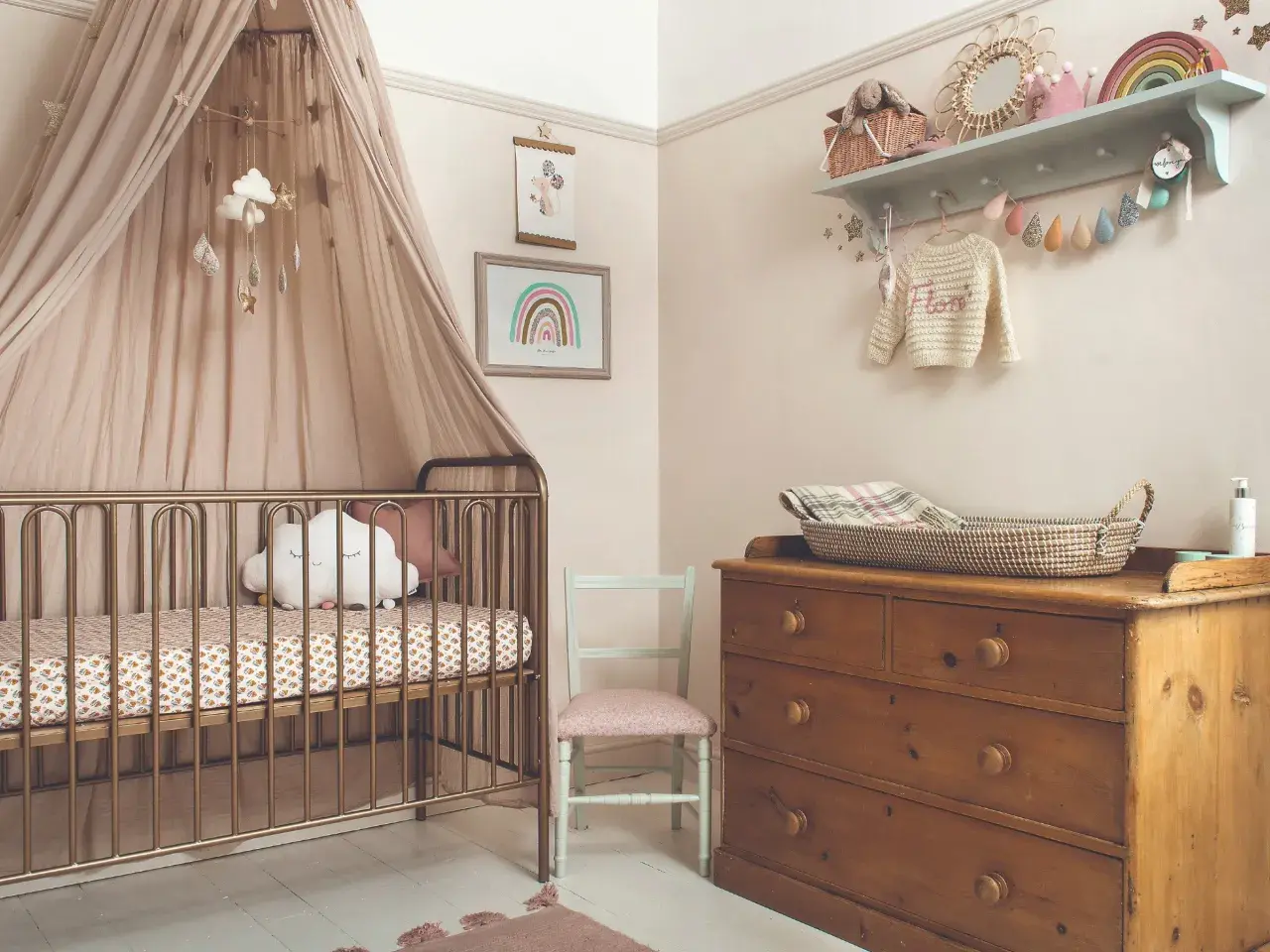
Designing a small nursery for a baby girl is less about cramming in more decor and more about making every square foot work. The room should feel soft and personal, but it also has to support feeding, changing, sleep, and storage without turning into a tight little obstacle course. The best small nursery ideas for a girl are the ones that make the room look airy while keeping the daily routine simple.
The smartest small nursery choices are calm colors, compact furniture, and vertical storage
- Plan the layout first so the crib, dresser, and chair each have a clear role.
- Use a light base palette and add femininity through texture, art, and one accent color.
- Choose furniture that does double duty, especially the dresser and changing area.
- Keep the floor open by using wall space, shelves, hooks, and baskets.
- Build a nursery that feels gentle at bedtime and practical at 2 a.m.

Start with a layout that gives every inch a job
I always start by taping the major furniture footprints on the floor before I buy anything decorative. In a small nursery, layout matters more than theme, because the room will feel roomy or cramped long before anyone notices the wall art. Aim for one clear sleep zone, one changing zone, and one comfortable seat for feeding or soothing.| Layout | Best for | Why it works | Watch out for |
|---|---|---|---|
| Crib on the longest blank wall | Rectangular rooms | Creates one strong focal point and leaves the center open | Keep it away from cords, vents, and bright window glare |
| Corner crib with dresser on the opposite wall | Narrow or oddly shaped rooms | Uses dead space efficiently and improves walking room | Leave enough clearance so drawers open fully |
| Three-zone setup | Small rooms with a little more width | Separates sleep, care, and feeding without extra partitions | Avoid overfilling the middle with decor or a second chair |
My rule of thumb is simple: if two people cannot move through the room without turning sideways, the layout is too busy. Once the footprint is set, color becomes the next tool for making the room feel larger.
Choose a palette that feels feminine without shrinking the room
A girl’s nursery does not need to be pink to read as feminine. In small rooms, softness comes from light, proportion, and texture more than from saturation. I prefer one pale base color, one natural wood tone, and one accent color that shows up in small doses rather than on every surface.
| Palette | Look and feel | Why it suits a small room | Best accent materials |
|---|---|---|---|
| Warm white, blush, and oak | Soft and classic | Keeps the room bright and visually open | Light wood, cotton, linen, cane |
| Cream, sage, and brass | Fresh and calm | Feels gentle without leaning overly sweet | Matte brass, woven baskets, soft wool |
| Dusty rose, oatmeal, and walnut | Warm and grounded | Adds personality while staying balanced | Walnut frames, textured rugs, boucle |
| Lavender-gray, ivory, and maple | Quiet and slightly whimsical | Brings color without making the room feel busy | Maple wood, simple prints, gauzy curtains |
If you want the room to feel larger, keep the ceiling and trim a shade lighter than the walls. That little shift matters more than most people expect. Next comes the furniture, and that is where small nurseries either become efficient or start to feel crowded.
Use furniture that does double duty
In a tiny nursery, every major piece should earn its place. I would rather see three smart pieces than five cute ones that only solve one problem. The most efficient setup is usually a crib, a dresser that can double as a changing station, and a compact chair that is genuinely comfortable for late-night feeds.
- Crib - Choose the safest style you can afford, but do not pay extra for elaborate shapes that eat space without adding function.
- Dresser - A 30 to 36 inch dresser often works well as the changing base because it stores clothing long after diapering ends.
- Changing top - A removable topper or pad lets the dresser return to normal use later, which is much smarter than buying a separate table.
- Chair - Measure the chair’s footprint and the swing room around it, not just the width of the seat. A chair that looks compact can still dominate a corner.
- Storage ottoman - Useful if it opens up for blankets, burp cloths, or backup swaddles, but only if the lid is easy to lift one-handed.
When space is tight, I like convertible furniture more than novelty pieces. A mini crib can make sense in a true nook, but only if you are comfortable with the shorter usable window. Otherwise, spend the money on a better dresser, better storage, and a chair that makes long feeds less tiring. From there, the room will still need a place for all the small things that babies somehow produce by the dozen.
Build storage vertically so the floor stays open
Small nurseries feel bigger when the floor stays visually quiet. That means getting serious about wall space, drawer organization, and closed storage. I try to give every category of baby item a home so the room does not slowly turn into a pile of folded clothes, spare diapers, and loose toys.
- Use the top drawer of the dresser for daily essentials like wipes, creams, and a small stack of diapers.
- Reserve one drawer for clothes in the current size and another for the next size up.
- Put blankets, extra sheets, and seasonal items in upper shelves or under-crib baskets.
- Install two or three floating shelves only if they stay lightly styled, not overloaded.
- Choose baskets with lids or handles for items you want to grab fast but not display all day.
- Keep one catch-all bin near the door for outgrown clothes, returns, or items that need to be washed.
Closed storage is usually better than open storage in a nursery this size. Open shelves look charming in photos, but they can make a room feel visually noisy if every inch is packed. Once storage is under control, you can move on to the fun part: choosing a theme that feels deliberate instead of generic.
Pick a theme that grows with her
Themed nurseries work best when the theme is more like a design direction than a costume. I like to think in layers: a color story, one repeating material, and one or two motifs that show up in the art, bedding, or rug. That keeps the room charming without making it feel temporary.
| Theme | Why it works | Best details to use | What to avoid |
|---|---|---|---|
| Modern blush and oak | Clean, soft, and easy to grow with | Simple crib, oak dresser, pale pink textiles | Too many tiny floral prints |
| Cottage garden | Feels sweet without becoming overly formal | Botanical art, soft stripe bedding, woven baskets | Heavy wallpaper on every wall |
| Soft celestial | Works especially well in small rooms because it feels airy | Moon prints, ivory bedding, gentle lavender accents | Dark navy everywhere unless the room has strong light |
| Vintage heirloom | Adds character and warmth in a compact footprint | Brass lamp, framed sketch art, a textured rug | Too many antique pieces that make circulation difficult |
| Neutral boho | Relaxed and flexible, especially for shared or future-use spaces | Cane details, gauze curtains, natural fiber rug | Overusing beige so the room loses depth |
I usually tell people to choose one standout detail and let the rest support it. A floral wall panel, a striped curtain, or a single vintage-style lamp is enough when the room is small. The next layer is lighting, and that is what makes the nursery feel calm at night instead of just decorated.
Light the room for bedtime, not just for photos
Lighting changes the mood of a nursery faster than almost anything else. In a small room, harsh light makes every edge feel sharper and every piece of furniture feel larger than it is. I prefer layered lighting: one overhead light on a dimmer, one soft task light near the chair, and blackout shades or curtains that help control naps.
- Use warm bulbs in the 2700K to 3000K range for a gentler glow.
- Install a dimmer if possible, because full brightness is rarely helpful at 2 a.m.
- Choose blackout window treatment if the room gets early morning sun.
- Place the feeding light near the chair so you do not have to light the whole room.
- Use a washable rug with a rug pad so the floor feels soft without becoming fussy.
A softly patterned rug can make a small nursery feel anchored, but I would avoid tiny, busy prints that break the room into pieces. Keep the light and textiles calm, and the room will feel larger even before you add the final layer of safety checks.
Keep the room safe and avoid the mistakes that make it feel cramped
I follow the same basic safety logic every time: the sleep space should stay simple, and the heavy furniture should stay anchored. HealthyChildren and the CPSC both emphasize the same core principles I use in practice: a firm mattress with a fitted sheet, no loose bedding or pillows in the crib, and dressers or shelves secured to the wall. In a small nursery, those basics matter even more because the room has less margin for clutter and tipping hazards.
- Keep the crib clear of bumpers, pillows, stuffed toys, and draped blankets.
- Anchor the dresser, shelves, and any tall storage unit to the wall.
- Avoid hanging strings, cords, or mobile pieces where a baby can reach them.
- Use cordless window coverings when possible, or keep cords completely out of reach.
- Do not place the crib so close to the window that curtains, blinds, or sunlight become a routine problem.
- Leave enough walking space that night feeds and diaper changes do not feel like an obstacle course.
The most common design mistake I see is overdecorating the nursery before solving the practical parts. A room can look lovely on day one and still fail if the drawers do not open, the chair is too bulky, or the crib area is cluttered. Once safety and circulation are handled, the budget becomes much easier to direct with purpose.
Spend first on the pieces that shape daily life
If I had to build a small nursery from scratch, I would spend in this order: crib and mattress, dresser or changing setup, chair, window treatment, lighting, then decor. That order keeps the room functional even if the styling is still unfinished. In the US, a fully new small nursery can land anywhere from about $500 to $2,500, depending on whether you reuse furniture and how premium the finishes are.
| Budget level | What I would buy first | Typical spend | Where to save |
|---|---|---|---|
| Tight budget | Paint, curtains, lighting, storage baskets, and one good rug | $150 to $500 | Reuse the dresser, borrow a chair, keep decor minimal |
| Mid-range | Crib, mattress, dresser, blackout shades, and wall storage | $500 to $1,500 | Skip matching sets and buy pieces individually |
| Full refresh | Higher-end crib, glider, custom window treatments, and layered lighting | $1,500 to $2,500+ | Limit specialty decor and put money into comfort |
The safest way to keep a small nursery from feeling overdone is to let function lead and decor follow. If the room works for feeding, sleep, and storage, the style will read as intentional even when the palette is simple. That is usually the difference between a nursery that looks cute online and one that feels good to live in every single day.
