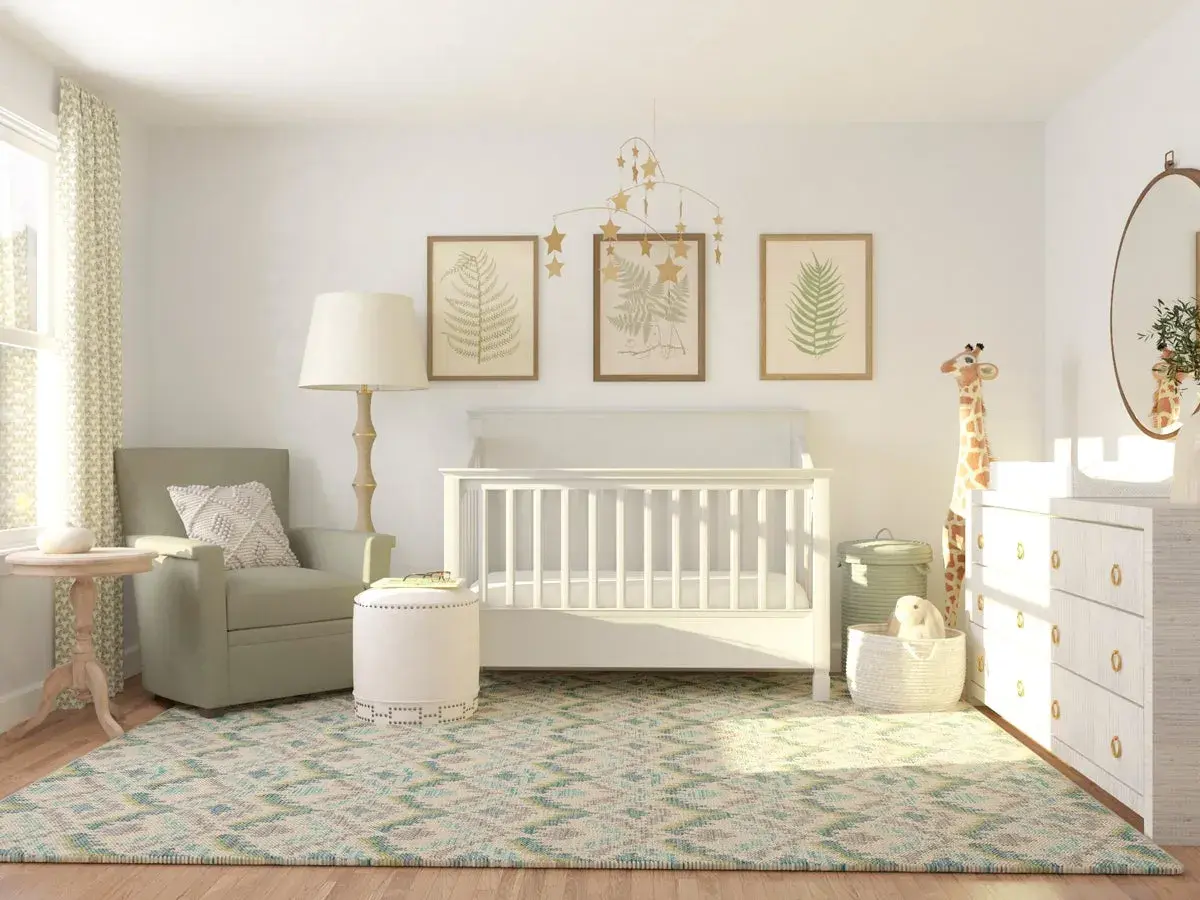
Decorating a baby’s crib area works best when the room feels calm first and styled second. The best crib decoration ideas do two jobs at once: they soften the nursery and keep the sleep space simple, secure, and easy to maintain. In practice, I focus more on the wall, the light, the color story, and the surrounding furniture than on the crib itself.
The safest nursery decor is the one that keeps the sleep zone clear
- Keep the crib itself bare apart from a fitted sheet.
- Put personality on the wall or in nearby decor, not inside the sleep space.
- Use one clear focal point and repeat 2 to 3 colors through the room.
- Choose pieces that can grow with the baby instead of designs that only work for newborn photos.
- Avoid cords, dangling fabric, and anything that could fall into or reach the crib.
Start with a safe sleep zone
The American Academy of Pediatrics recommends a firm, flat sleep surface and says the crib should contain only a fitted sheet. The CPSC also warns that soft objects can block a baby’s airway, which is why bumpers, blankets, pillows, and sleep positioners stay out of the crib. I use that guidance as my first design filter: if a piece belongs inside the sleep zone, it has to pass a safety test before it passes a style test.
I also avoid anything that changes the sleep surface. Any incline over 10 degrees is not considered safe for sleep, so the focus should stay on a proper crib, a tight mattress fit, and clean airflow around the crib. If the nursery has a window nearby, I keep the crib away from cords, blinds, and dangling hardware. That single choice removes a surprising amount of risk.
| What I avoid | Better placement | Why I treat it that way |
|---|---|---|
| Crib bumpers, pillows, blankets, plush toys | Not in the sleep space at all | Soft objects can interfere with breathing or create entanglement hazards. |
| Long ribbons, cords, blind chains | Replace with cordless window treatments or secure them well away | Loose cords can become a strangulation hazard. |
| Crib placed directly under a window | Against a solid interior wall | Reduces access to cords and falling hazards. |
| Heavy decor directly above the crib | Adjacent wall or securely anchored higher up | Limits the chance that something falls into the sleep area. |
| Any sloped sleeper or positioner | Flat mattress with a fitted sheet only | A flat, firm surface is the safer standard for infant sleep. |
Once the sleep zone is clear, the fun part is choosing a focal point that gives the room personality without adding clutter.

Pick one focal point above the crib
The wall above the crib usually does most of the visual work in the room, so I like to treat it as the main design anchor. One strong focal point is enough. If you overload that wall with too many small pieces, the nursery starts to feel busy instead of calm.
Framed art and name signs
Framed prints, a single oversized illustration, or a clean name plaque work because they read clearly from a distance. Botanical art, animal sketches, and simple typography are especially effective when you want the crib area to feel personal without becoming themed. I prefer larger pieces over tiny ones; small art gets lost fast and usually makes the wall feel underplanned.
Wallpaper panels and murals
If you want a stronger statement, a removable wallpaper panel or a painted arch behind the crib gives the room depth without adding objects into the sleep space. This is one of the best options for smaller nurseries because it creates a backdrop, not extra furniture. In a room that already has a lot going on, a mural can be the thing that makes everything else finally make sense.
A mobile used as a visual accent
A mobile can be beautiful, but I treat it as temporary decor rather than permanent nursery furniture. If you use one, keep it safely out of reach and remove it once the baby can push up, grab, or sit up with more control. I also prefer simpler shapes and softer colors; the goal is to calm the room, not turn the crib into a toy display.
Read Also: Baby Girl Room Design - Beyond Pink: Style & Function
Keep the composition balanced
Visually, the best crib wall usually has one center of gravity. That can be a centered print, a large name sign, or a mural panel, but it should feel intentional. If you want symmetry, use matching frames or twin prints. If you want asymmetry, keep the shapes clean and the spacing generous so the wall still breathes.
When the focal point is right, the next decision is color, because color determines whether the room feels soothing or overstimulating.
Build a color story that feels calm
I usually start with one base color, one secondary tone, and one accent, then repeat them throughout the nursery. That gives the space consistency without making it look overdesigned. In a crib area, restraint is usually the stronger move, especially if the rest of the home already has a lot of visual texture.
| Color role | Share of the room | Examples | Where it works best |
|---|---|---|---|
| Base | About 70% | Warm white, oat, pale gray, soft cream | Walls, crib finish, large storage pieces |
| Secondary | About 20% | Sage, dusty blue, blush, clay, muted terracotta | Rug, curtains, chair upholstery, wall art |
| Accent | About 10% | Black, brass, rust, mustard, deeper green | Frames, knobs, baskets, small decor pieces |
I also keep the number of dominant colors low. Two or three is usually enough. More than that, and the crib area can start to feel like a sample board instead of a room. If you are painting, low-VOC paint is worth considering; it releases fewer volatile organic compounds, which is why many parents prefer it in nurseries.
Texture matters just as much as color here. A woven basket, a soft rug, a matte frame, and a smooth crib finish can make a simple palette feel layered without adding visual noise. That is often what people are really after when they say they want the nursery to feel cozy.
Choose a style direction and repeat it
If I were styling a nursery from scratch, I would pick one clear direction and echo it in at least three places: the wall, the storage, and one textile or accessory. That is how a room feels designed instead of assembled. It also keeps the crib area from becoming a mashup of good ideas that never quite settle into one story.
| Style direction | What I would use | Why it works |
|---|---|---|
| Soft botanical | Leaf prints, pale green accents, natural wood, woven storage | Feels fresh and calm without leaning too hard into a theme. |
| Modern neutral | Warm white walls, oak tones, black frames, simple typography | Clean, timeless, and easy to grow into as the baby gets older. |
| Storybook animal | Illustrated animals, felt or paper details, a gentle character motif | Playful enough for a nursery, but still easy to keep balanced. |
| Celestial night sky | Moon art, star accents, muted navy, dimmable light | Creates a soft nighttime mood that feels especially soothing near a crib. |
| Warm color-blocked | Painted arch, terracotta, sand, sage, one bold accent piece | Looks current without depending on lots of objects or busy patterns. |
In 2026, the most durable nursery looks still tend to be the least fragile ones: warm neutrals, natural textures, and one playful detail instead of a room full of them. That does not mean the room has to feel plain. It means the design has room to breathe.
Once you know the style direction, it becomes much easier to spend money only where it will actually change the room.
Add budget-friendly details that look custom
The fastest way to make the crib area feel finished is to spend on one or two larger anchors and stop there. Small decor items add up quickly, but they rarely move the room the way scale does. If I were prioritizing a budget, I would rather have one good print, one good rug, and one strong storage solution than five little decorations fighting for attention.
| Upgrade | Typical U.S. budget range | Best use |
|---|---|---|
| Framed art set | $30 to $120 | Creates an instant focal point above or beside the crib. |
| Peel-and-stick wallpaper panel | $40 to $200 | Adds a custom look without committing to permanent wallpaper. |
| Custom name sign | $25 to $150 | Makes the nursery feel personal without crowding the room. |
| Woven baskets | $20 to $80 | Hide diapers, swaddles, and toys while adding texture. |
| Washable rug | $60 to $250 | Softens the room and helps define the crib zone. |
| Dimmable lamp or wall sconce | $30 to $180 | Supports nighttime feeds and keeps the room usable after dark. |
If the budget is tight, I would spend first on the wall, the floor, and storage. Those three choices change how the whole room feels. If the budget is looser, a single custom piece can be the difference between a nursery that looks generic and one that feels thoughtful.
The real trap is not spending too little. It is adding too many small things because each one seems harmless on its own.
Avoid the mistakes that age a nursery fast
The nurseries that feel busy usually fail in the same few ways. They collect too many tiny objects, rely on one-note themes, or treat the crib like the center of the design instead of the baby’s sleep space. I pay attention to those failures because they are easy to make and harder to fix once the room is already full.
- Overcrowding the wall with lots of small frames instead of one or two clear pieces.
- Mixing too many themes, such as animals, stars, rainbows, and travel motifs all at once.
- Using fragile decor where it could be knocked down later by a curious toddler.
- Ignoring cords and windows, which creates clutter and safety issues in the same move.
- Designing only for newborn photos and forgetting that the room has to work during middle-of-the-night wakeups too.
My rule is simple: if something makes the room look lovely but gets in the way of sleep, cleaning, or movement, it is probably the wrong item for that spot. A nursery should feel gentle, not staged.
That is why the most successful crib area decor usually has some empty space left in it. The room does not need to be full to feel complete.
The crib area I would keep as the baby grows
If I wanted the nursery to age well, I would choose pieces that still make sense after the crib becomes a toddler bed. That means art you still like at age three, a palette that does not depend on one trend, and storage that can shift from diapers to books and blocks. I would also keep sentimental pieces out of the sleep space itself and use them in safer, more flexible places around the room.
The most useful crib decoration ideas are the ones that make the nursery feel calm on day one and still feel right a year later. That is the balance I would aim for every time: a clear sleep zone, one strong visual story, and enough softness around the edges to make the room feel warm without becoming crowded.
