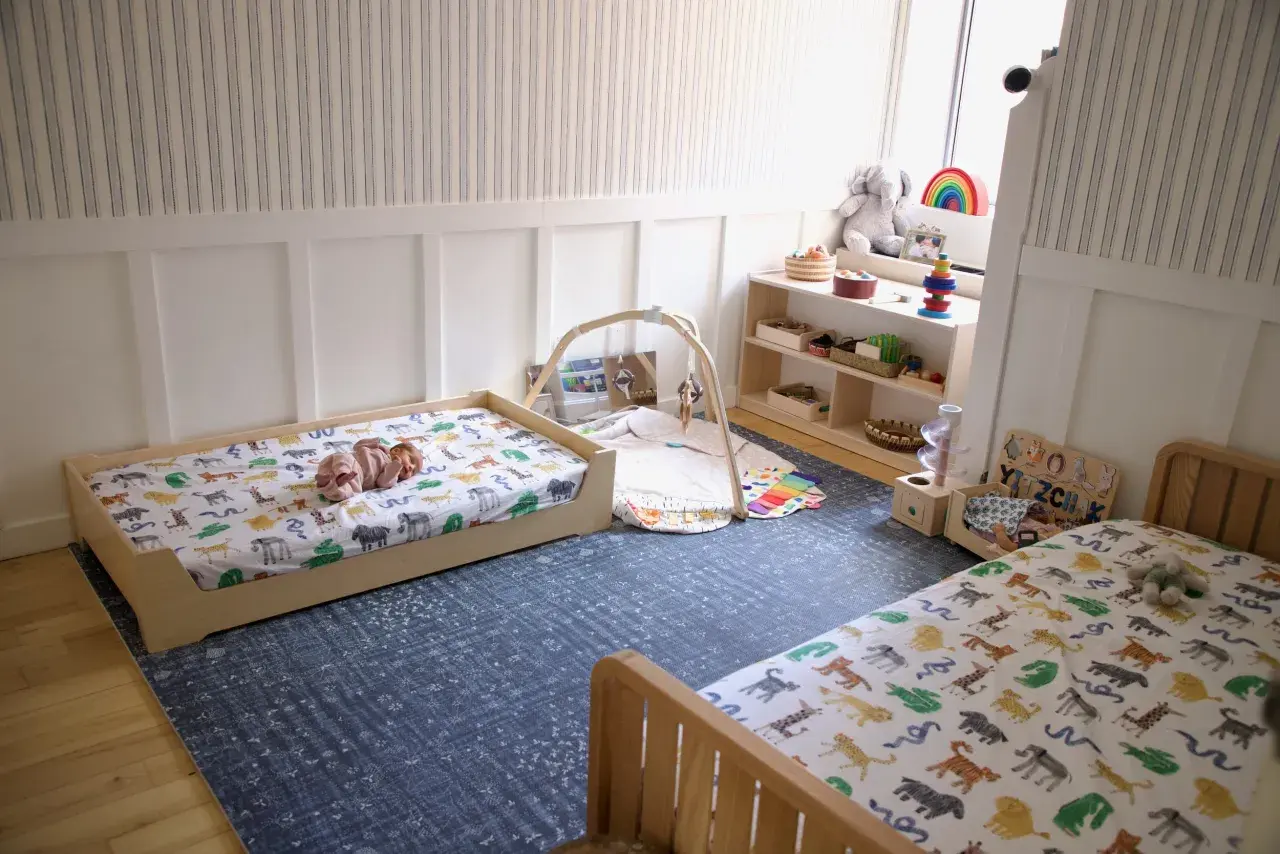
The safest setup starts with the room, not the mattress
- For babies under 1, I would stick with a crib, bassinet, or play yard that meets federal safety standards.
- A floor bed is mainly a toddler transition, not an infant sleep shortcut.
- The room has to be childproofed end to end, including furniture, cords, windows, and stairs.
- Keep the sleep surface firm and simple, with no soft add-ons that change how the mattress behaves.
- Watch the first few nights closely, because children quickly find the weak spots in any setup.
What a floor bed is and why families choose one
I use “floor bed” to mean a mattress on the floor or on a very low base, usually for a toddler moving out of a crib. Families like the idea because it gives a child more independence, reduces the height of any fall, and can make bedtime feel less like a battle. But I treat it as a room-design choice, not a furniture choice. If the room is not ready, a low mattress simply gives a child easier access to hazards.
| Setup | Best fit | Main strength | Main limitation |
|---|---|---|---|
| Crib | Infants under 1 | Contained, predictable sleep space | Not suitable once the child starts climbing out or outgrows it |
| Floor bed | Ready toddlers and some preschoolers | Easy access and lower fall height | Requires full room proofing and consistent boundaries |
| Toddler bed | Children who need a more familiar bed shape | Feels like a transition from the crib | Can still allow climbing and wandering if the room is not controlled |
That difference matters most when you look at age and readiness, which is the next question I always ask.
Who is ready for a floor bed and who is not
The AAP still treats infant sleep as a firm, flat, bare-surface problem, so I do not think of a floor bed as an infant option. For younger babies, the safest answer is still a crib, bassinet, or play yard that meets current safety standards. For toddlers, the decision shifts from “Which bed?” to “Is the whole room safe enough to function like the bed rails used to?”
| Child stage | What I would do | Why |
|---|---|---|
| Under 12 months | Use an approved infant sleep space | Infant sleep rules are stricter and the room should not replace a safe sleep product |
| 12 to 18 months | Keep the crib unless the child is climbing out or the crib is no longer a safe fit | Many children this age still need containment at night |
| About 18 months to 3 years | A floor bed can make sense if the room is fully proofed | This is a common transition window for independence |
| Older preschoolers | Either a floor bed or a regular bed can work | At this point, sleep habits and room setup matter more than the bed style itself |
A practical trigger is behavior, not a birthday. If a child can climb out of the crib or is around 35 inches tall, I stop thinking about crib life and start planning the next sleep setup. If you are between stages, a crib mattress on the floor can work as a temporary bridge while you finish childproofing and decide on a longer-term bed.

How to room-proof the space around the bed
Once a child can get out of bed on their own, the room becomes the safety boundary. I want the space to behave like a giant crib: no tip-over furniture, no dangling cords, no easy access to stairs, and no tempting climbable furniture near the mattress. CPSC guidance is blunt on this point, and I agree with it. Furniture tip-overs, accessible blind cords, and unsecured windows are not minor background risks.
- Anchor dressers, bookcases, TVs, and other tall furniture to the wall or floor.
- Use cordless window coverings whenever possible, and keep any remaining cords completely out of reach.
- Install a gate at the bedroom door if wandering is likely, and a gate at the top of stairs when needed.
- Secure windows if they are reachable from the bed or from furniture that could be climbed.
- Keep chargers, lamps with cords, and small objects off the floor so they do not become grab points or choking hazards.
- Remove rockers, step stools, and large toys that can turn into climbing aids at night.
I like to imagine the child moving around the room in low light, half-awake and curious. If something would be dangerous in that state, it does not belong within reach of the bed. After the room is safe at floor level, the mattress and bedding choices become the next layer.
Mattress and bedding choices that support safer sleep
My rule here is simple: firm, flat, and boring. A mattress that indents deeply when pressed is too soft. If you are using a crib mattress, it should fit the crib exactly; for a floor bed, the same idea still matters, because loose edges and awkward gaps create traps. I would rather see a plain, stable sleep surface than a cozy setup that looks nice in photos but adds risk.
- Keep the mattress firm and low. The child should not sink into it.
- Avoid toppers and thick protectors that make the surface softer or change the fit.
- Skip bumper-style padding and pillow piles around the edges.
- Use only simple bedding. For infants, that means a fitted sheet only; for older toddlers, keep blankets light and easy to move.
- Inspect any frame or low platform for sharp edges, pinch points, or gaps before the first night.
If you are trying to make the bed feel warmer or more inviting, I would do that with room temperature, lighting, and routine first. Bedding should help sleep, not complicate it. Even a good mattress choice can be undone by a few predictable mistakes, which is where many parents get tripped up.
Common mistakes that make a floor bed less safe
The biggest mistake is thinking the low mattress is the safety plan. It is not. The bed only works when the room has been stripped of the easy hazards a child can reach in the dark or half-asleep. I see the same problems over and over:
- Moving too early. Babies need an approved infant sleep space, not a low mattress on the floor.
- Adding cozy extras too soon. Decorative pillows, heavy quilts, and stuffed piles create more risk than comfort for younger children.
- Putting the bed near cords or windows. A low bed makes those hazards easier to reach, not harder.
- Leaving furniture unsecured. A child who can climb out of bed can also climb a dresser drawer.
- Ignoring the door and stairs. Once the child can get out of bed, room access matters as much as the mattress.
- Leaving climbable toys right beside the bed. What looks harmless at bedtime can become a step stool at 2 a.m.
I would rather remove one hazard than rely on a child’s self-control to compensate for it. That mindset makes the setup cleaner and usually easier to live with, which is why I finish with one last check before I call the room ready.
The checks I would make before the first night
- Kneel at the child’s height and scan for cords, sharp corners, and gaps.
- Pull lightly on furniture to confirm that dressers, shelves, and TV stands are anchored.
- Test the door and any gate from the child’s side, not just from yours.
- Look for anything the child could climb to reach a window, shelf, or handle.
- Recheck the setup after a few naps because children expose weak spots fast.
If the room stays boring, predictable, and free of easy hazards, a floor bed can be a useful step toward independence. If you still have to worry about cords, stairs, or unstable furniture, keep editing the room before you call the setup finished.
