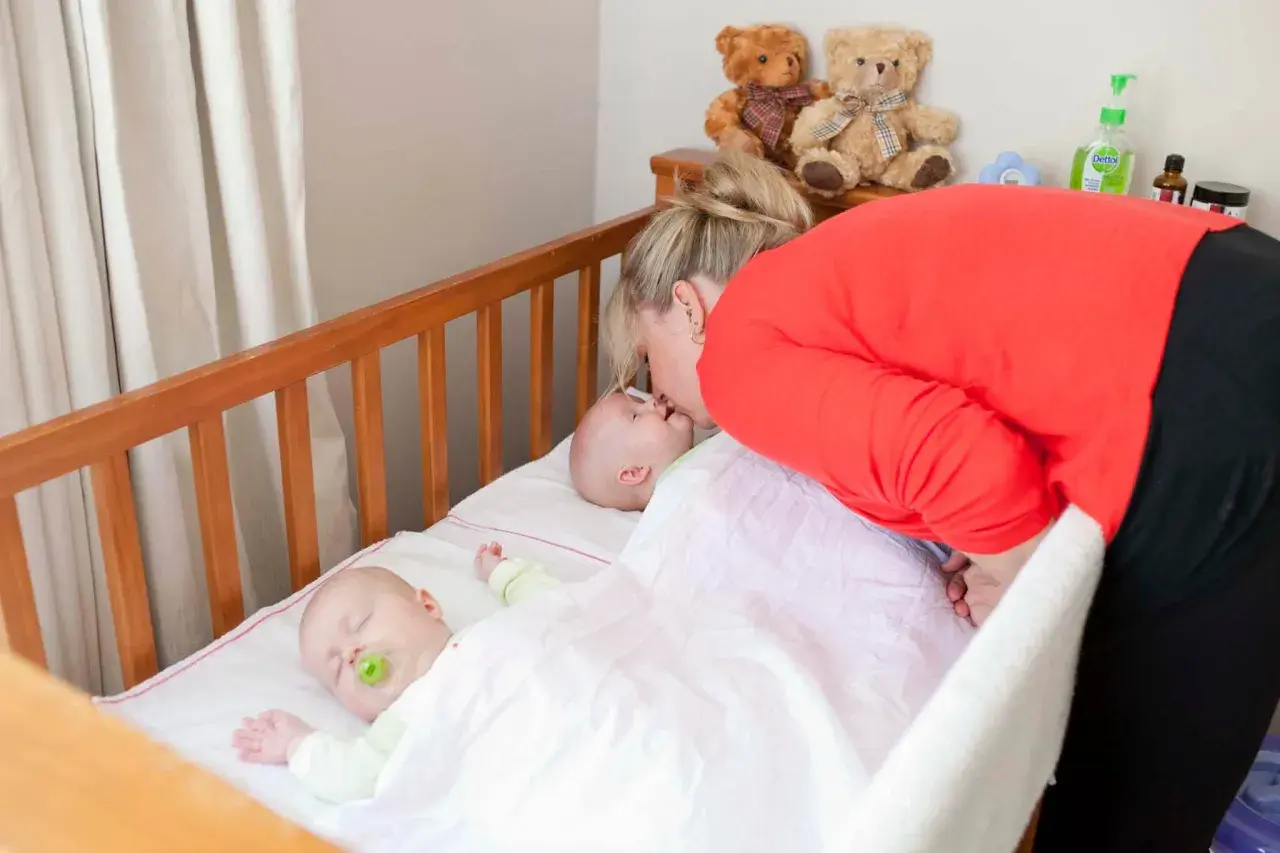
A twin nursery works best when the sleep setup is simple, firm, and easy to manage at 2 a.m. The phrase double baby cribs usually points to twin-friendly sleep setups, but in practice the real decision is about safety, space, and how long the furniture will actually serve you. I am focusing here on what matters in a U.S. nursery: what the term really means, which options are worth considering, and how to avoid buying something that looks clever but works poorly.
The safest twin nursery keeps two separate sleep spaces and a firm, well-fitting mattress
- In the U.S., I treat separate sleep spaces as the default for twins, not one oversized shared crib.
- The American Academy of Pediatrics recommends room-sharing without bed-sharing for at least the first 6 months.
- A crib mattress should fit tightly and the sleep surface should stay bare except for a fitted sheet.
- Two full-size cribs give the longest runway, while mini cribs and twin bassinets save space in smaller rooms.
- Budget for the mattress, sheets, and room layout, not just the crib frame itself.
- Used cribs and unclear product listings are where many parents make expensive, avoidable mistakes.

What the term usually means in practice
When people talk about twin cribs, they usually mean one of three things: two separate cribs in the same room, a twin bassinet or multi-baby sleep unit for the newborn stage, or a marketing shortcut for a nursery setup meant for two babies. I separate those ideas immediately, because the label alone does not tell you whether the product is actually useful or safe.
In the U.S. market, I do not see “one crib for two babies” as the standard long-term answer. What I do see is a lot of confusion between space-saving newborn products and proper cribs. That matters, because the wrong interpretation can lead parents to buy furniture that is too small, too temporary, or too risky once the babies start moving more.
So my first question is never “Does it sound convenient?” It is “What sleep problem is this solving, and for how long?” That question leads directly into the safety rules that should shape every twin nursery decision.
Why safety matters more than the product label
The U.S. safe-sleep guidance is pretty clear: infants should sleep on their backs, on a firm and flat surface, with a fitted sheet only, and in their own sleep space. The American Academy of Pediatrics also recommends room-sharing without bed-sharing for at least the first 6 months, and it notes that room-sharing can lower SIDS risk by as much as 50%. That is the baseline I would use before I look at style, storage, or price.
For twins, the biggest mistake is assuming that “close together” and “safe together” mean the same thing. They do not. A shared sleep surface can create crowding, contact between bodies, and a higher chance of airway obstruction as babies grow and start to move. If I were advising a family directly, I would treat any shared-crib arrangement as an edge case that needs extra caution, not as the default plan.
The other part of safety is fit. The CPSC says a full-size crib mattress has standardized dimensions, and the mattress needs to fit the crib tightly. In plain language, that means no gaps, no improvised padding, and no soft add-ons in the sleep space. That is why a crib that looks roomy in a product photo can still be a poor choice in real life.
Once that baseline is clear, the real question becomes which setup gives you the best blend of safety, space, and daily usability.
The sleep setups I would compare first
When I compare nursery options for two babies, I look at how they perform in three situations: newborn nights, the rolling stage, and the period when you are constantly reaching in to lift one baby or the other. The table below is the fastest way to see the trade-offs.
| Option | Best for | Main strength | Main trade-off | Typical U.S. budget |
|---|---|---|---|---|
| Two full-size cribs | Long-term nursery use | Most flexible and easiest to keep separate | Takes the most floor space | $300-$1,200 for the pair, before mattresses |
| Two mini cribs | Smaller rooms or apartments | Compact and easier to fit near a bed or dresser | Babies outgrow them sooner | $220-$700 for the pair, before mattresses |
| Twin bassinet or two bassinets | Newborn stage | Keeps babies close for night feeds and early monitoring | Short useful window | $120-$400 total, depending on the design |
| Portable play yard | Travel or temporary overflow sleep space | Useful as a backup and easy to move | Usually not my first pick for a permanent nursery | $100-$250 |
My practical read is simple: two full-size cribs are the cleanest long-term solution, while mini cribs and twin bassinets are the more space-conscious bridge. If your nursery is tight, that bridge can be extremely helpful, but I would still plan the next stage early so you are not forced into a rushed transition later.
That comparison is only useful if the room itself can support the setup, which is where layout becomes the next real constraint.
How to fit two sleep spaces into one nursery
I always measure the room before I buy anything. Two sleep spaces plus walking room can eat floor area faster than people expect, especially once you add a dresser, changing station, and storage for diapers and swaddles. If you want two full-size cribs, I would think in terms of a nursery that gives you enough wall length to place both without turning the room into a squeeze.
A smaller room can still work, but then every inch matters. Keep the cribs away from windows, cords, blinds, and anything climbable. Leave enough clearance to reach each baby without dragging your body across a railing or corner. If the room feels crowded before the babies arrive, it will feel worse once you are changing sheets, carrying laundry, and doing one-handed pickups at night.This is also where people underestimate the value of a smaller footprint. A mini crib can buy you breathing room in an apartment or a shared bedroom, and a twin bassinet can make the first months easier if your bedroom is where most night care happens. The best layout is not the one that looks most complete on day one; it is the one that still works when you are tired and moving fast.
Once the room is mapped out, the next step is choosing the crib itself with a stricter eye than most nursery guides use.
What I look for when buying a crib for twins
For twins, I look for the same safety basics I would want for any crib, then I raise the bar on practicality because you are buying twice. That means fewer weak points, fewer surprise costs, and fewer things that become annoying after the first week.
- Firm, flat support with a mattress that fits tightly and leaves no visible gaps.
- Stationary sides rather than older drop-side styles or anything that looks modified.
- Clear weight and height limits so you know when the transition away from the crib starts.
- Easy assembly because twin parents rarely want a complicated build at the end of a long day.
- Simple cleaning and durable finishes, especially if you expect frequent sheet changes and spills.
- Convertible design only if it is truly useful; I would not pay extra for a conversion path you may never use.
- Verified recall history and original hardware if you are considering anything secondhand.
- Optional low-emission materials if odor or finish sensitivity matters to your family, but not at the expense of fit and safety.
I also like to think about the whole purchase, not just the frame. A crib is only part of the cost. Add the mattress, fitted sheets, and any storage you need near the sleep area, and the budget moves quickly. In U.S. retail, a good crib can easily end up in the $200-$600 range each once you move past entry-level options, and mattresses often add another $90-$250 per baby.
That is why the next section matters: the wrong assumptions can make a reasonable purchase feel expensive and a safe purchase feel inconvenient.
Mistakes that cost time and money
The most common mistake I see is buying on looks alone. A nursery photo can make a product feel smarter than it is, but sleep setup is one place where the photo never tells the whole story. If the mattress fit is wrong, the room layout is cramped, or the product is too short-lived, you pay for that later in frustration.
Another expensive mistake is buying used without checking the full history. I would avoid secondhand cribs unless you know the model, the hardware is complete, the instructions are available, and there is no recall risk. A bargain crib that is missing parts is not a bargain. It is a problem you have to solve before the baby ever uses it.
Parents also underestimate the speed of change with twins. What works for sleepy newborns may not work once one or both babies start rolling, pushing up, or reaching the crib rails. If you buy a setup that only works for a few weeks, that may still be fine, but you should buy it as a deliberate bridge, not as the final answer.
And one more: do not let marketing language override the safety basics. If a product promises convenience but is vague about sleep standards, I treat that as a warning sign, not a feature.
The setup I would choose first
If I were building a twin nursery from scratch, I would start with two separate safe sleep spaces and choose the size based on the room, not the advertising. In a larger nursery, two full-size cribs are the best long-term move. In a smaller space, two mini cribs or a twin bassinet for the newborn stage can be smarter, as long as I already know when the transition to cribs will happen.
That is the part most people miss: the “best” choice is usually the one that fits your next six months, not just the first two weeks. I want a setup that is easy to use when I am exhausted, easy to clean when I am behind, and easy to outgrow when the babies are ready for the next step.
If you keep the decision that simple, the whole process gets easier. You end up buying sleep furniture that supports the real job of parenting twins: keeping both babies safe, making night care manageable, and avoiding a nursery that fights you every single day.
