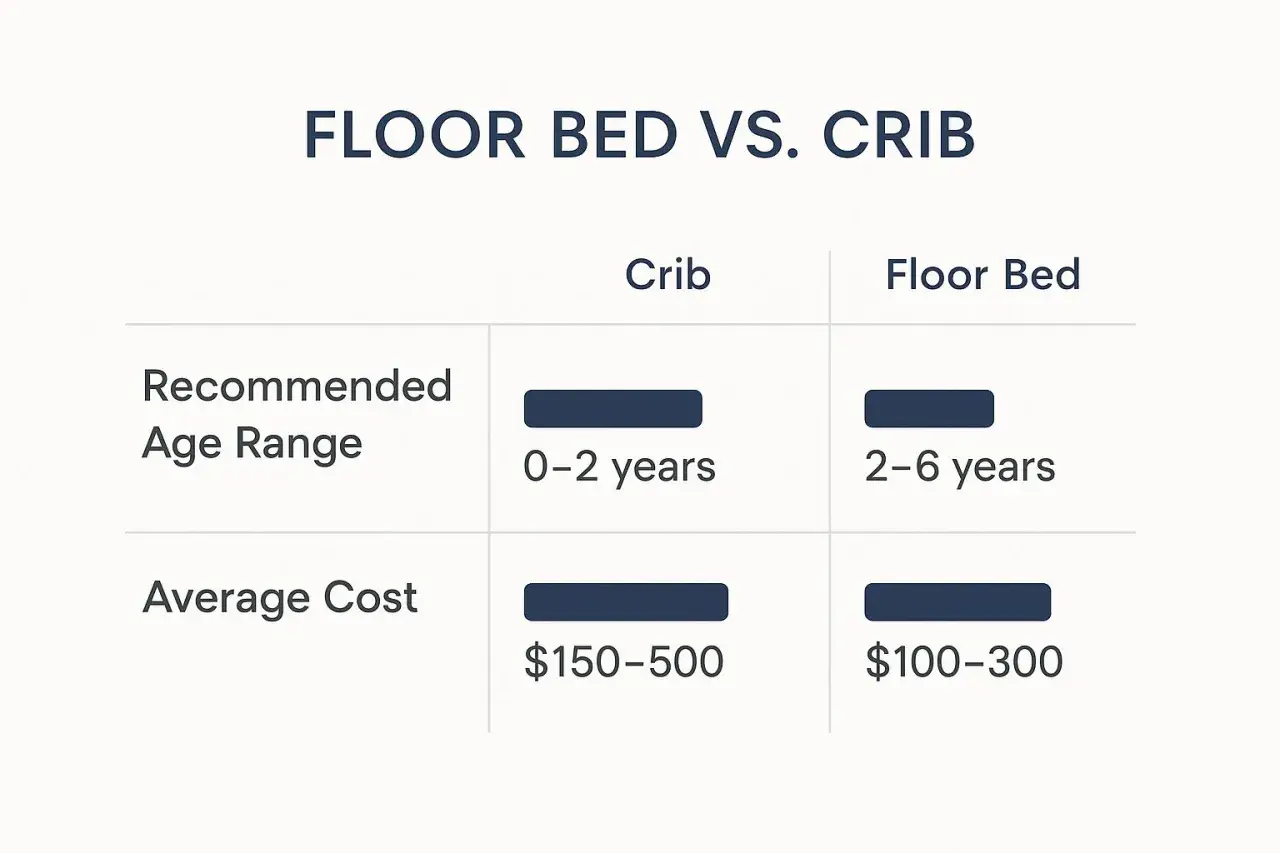
The floor bed vs crib decision is really about choosing between independence and containment, but the right answer depends more on age, room safety, and sleep habits than on nursery style. In this article, I break down when each setup makes sense, where the safety lines are, and how to avoid the common mistakes that turn a good idea into a bad night. I also want to make the trade-offs practical, because the best sleep setup is the one you can keep safe and consistent.
The safest choice depends on your child’s age, mobility, and how much control the room gives you
- For infants under 12 months, I would treat a crib as the default.
- A floor bed makes more sense once a child is mobile and the room is fully childproofed.
- Room sharing for at least the first 6 months is still the safer pattern for babies.
- A low mattress does not automatically make a sleep space safe for an infant.
- If a child can climb out of the crib, a mattress-on-the-floor transition can be a sensible bridge.
What each sleep setup really means
A floor bed is usually a mattress placed directly on the floor or on a very low frame. A crib is an enclosed sleep space built to current safety standards, with a firm mattress and hardware designed to keep a baby from slipping through gaps or climbing out too early. That difference sounds simple, but it changes almost everything: how much the child can move, how much the room has to do, and how much margin you have when bedtime gets messy.
In practical terms, the crib is a sleep container. The floor bed is a room strategy. Once the mattress comes off the crib rails, the room itself becomes part of the sleep system, which is why the rest of the nursery matters so much more.
That is the point where safety stops being a side note and becomes the main decision.
Safety comes first in the first year
I start here because it changes the answer for babies under 12 months. The safest setup is a firm, flat, noninclined sleep surface with no soft bedding, and room sharing for at least the first 6 months is strongly favored. The CPSC crib guidance is straightforward: a tight-fitting mattress, a fitted sheet, and nothing bulky in the sleep space.- Place the baby on their back for every sleep.
- Keep the sleep area bare except for a fitted sheet.
- Share the room, not the bed, for at least the first 6 months.
- Move a baby to a safe sleep space if they fall asleep elsewhere.
- Do not assume a low mattress makes an infant sleep setup safe by default.
My rule is simple: if the child is still in the infant stage, the crib is the safer default. A floor mattress may look calm and minimal, but minimal design is not the same thing as infant-safe design. Once that line is clear, the floor-bed option becomes much easier to judge for older children.
And that is where some families start to see real benefits.
Where a floor bed can make sense
A floor bed can work well when a child is already mobile, can get in and out without help, and is ready for a little more autonomy. I especially see value in homes where bedtime power struggles are the real problem: the child wants control, parents want less lifting, and everyone benefits from a setup that feels less like confinement. It can also make middle-of-the-night soothing simpler, because you can lie beside a toddler without hauling a sleepy child in and out of a crib.
The upside is real, but so is the catch. A floor bed only feels easy when the room is fully childproofed, the child does not wander into hazards, and you are comfortable with the idea that bedtime may not keep the child in one spot every night. In other words, the bed is low, but the supervision burden is not.
For the right child, that trade-off is worth it. For the wrong child, it just turns sleep into a roaming problem.
Why a crib still solves more problems for infants
Cribs still solve the most problems for infants because they create boundaries that the room does not have to provide. That matters during frequent night wakings, short naps, and the early months when you want a predictable place to put the baby down and walk away with confidence. For many families, that predictability is worth more than the visual simplicity of a floor setup.
The crib also gives you a cleaner transition point. The AAP notes that once a child can climb out of the crib, putting the mattress on the floor is a safer interim step than pretending the crib still fits the child. That is the kind of advice I like because it follows behavior instead of forcing a nursery trend.
In other words, the crib is not just a piece of furniture. For babies, it is the structure that makes safe sleep easier to repeat.

How they compare side by side
| Factor | Floor bed | Crib | What it means |
|---|---|---|---|
| Best stage | Usually after infancy, once the room is fully childproofed | Infancy and the crib stage | The crib is the default for babies |
| Safety margin | Depends heavily on room safety and supervision | Higher when assembled correctly | The crib carries less room-level risk |
| Independence | High | Lower | Floor beds can reduce bedtime battles |
| Containment | Low | High | Cribs are better for wanderers and light sleepers |
| Up-front cost | Usually lower | Usually higher | Lower furniture cost does not remove safety prep |
| Room prep | Very high | Moderate | Floor beds shift work to outlets, cords, furniture, and clutter |
| Transition out | Easier for some toddlers | Can delay transition until climbing starts | Use behavior, not aesthetics, to decide |
I read that table one way: cribs reduce risk and simplify nights, while floor beds increase autonomy but move more responsibility to the room. That is why the right choice often depends less on taste and more on how much chaos your child brings to bedtime.
Common mistakes that erase the upside
Most bad outcomes come from people choosing the right idea for the wrong child, or the right child in the wrong room. A floor bed is not magic, and a crib is not foolproof if it is used carelessly.
- Switching to a floor bed because it looks developmentally “right” on social media, not because your child is actually ready.
- Leaving chargers, blind cords, small objects, or heavy furniture within reach.
- Using pillows, thick blankets, bumpers, or plush bedding too early.
- Assuming a crib is safe without checking the mattress fit, hardware, and overall assembly.
- Waiting until the child is repeatedly climbing out before making a plan.
The pattern is easy to spot: the sleep surface itself is only part of the story. If the room is not set up correctly, a floor bed loses its main advantage, and a crib loses some of its protection.
That leaves the final step, which is deciding what fits your child right now instead of what feels trendy.
The simplest way to choose without overthinking it
When I reduce the floor bed vs crib choice to one rule, it is this: use a crib for babies, and use a floor bed only when your child is old enough to handle the freedom and the room is already safer than the furniture would be. If a child is under 12 months, the crib should still be the default. If a toddler is climbing out, fighting the enclosure, and living in a fully childproofed room, a floor bed can be a sensible next step.
- Choose a crib if your child is still in the first year.
- Choose a crib if the room is not fully childproofed.
- Choose a floor bed if you want more independence and the child can move safely in the room.
- Choose the floor-mattress bridge if your child is climbing out but not ready for a big bed.
The best setup is the one that stays safe on an ordinary Tuesday night, not just the one that looks best in a nursery photo. If you want a clean answer, start with age, then childproofing, then temperament, and let the bed follow the child instead of the other way around.
