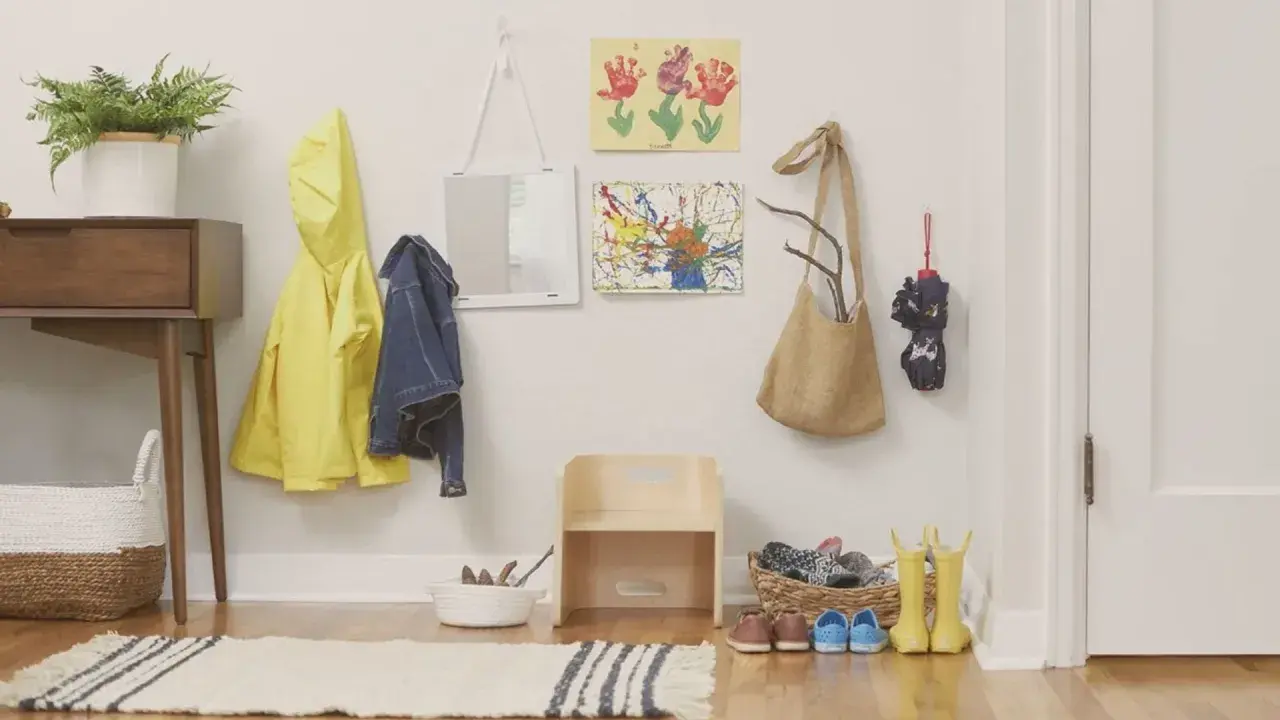
A Montessori-style entryway can remove a surprising amount of friction from the day. When a child can reach the hooks, sit down to manage shoes, and see a simple place for outerwear, mornings get calmer and the space starts teaching order instead of just storing it. These Montessori entryway ideas focus on practical life first: independence, visual clarity, and a layout that a child can actually use.
What matters most in a child-friendly entryway
- Keep the station simple. One coat, one pair of shoes, and one bag per child is usually enough.
- Prioritize reach and sequence. The child should be able to sit, hang, see, and choose without help.
- Use open, low storage. Baskets, hooks, and a small bench work better than deep bins or closed clutter.
- Match the setup to the age. A toddler’s needs are different from a preschooler’s or a sibling group’s.
- Keep the visual field calm. Fewer objects make the routine easier to follow.
- Plan for weather and seasons. A simple cue for coats, hats, and shoes helps children make better choices.
What a Montessori entryway is supposed to do
The goal is not to create a decorative nook that looks good in photos. The goal is to give a child a practical place to prepare for leaving and returning home. In Montessori terms, this is a small practical-life station: the child learns to manage belongings, make choices, and complete a sequence of actions with less adult intervention.
I think that distinction matters because many entryways fail in the same way. They hold too much, sit too high, and require adult hands for every step. A true child-centered entrance should reduce the number of reminders you give in a day. A Montessori Foundation room-by-room checklist puts the same essentials first, especially low hooks, a small seat, shoe storage, and a mirror at child height.
When the space is prepared well, you usually see three things happen: the child remembers where items belong, gets dressed with less resistance, and starts noticing what belongs in the home and what belongs on the way out. That sets the stage for choosing the right size and structure for your child’s age, which is where the next decisions become much easier.
How to match it to age and daily routine
A setup for a 14-month-old should not look identical to one for a 4-year-old. Young toddlers need fewer choices and more repetition. Preschoolers can manage more categories, but they still benefit from a clear, narrow routine rather than a crowded wall of options.
I usually think in terms of active set, meaning the items the child actually uses every day. For many families, that means keeping only three to five things visible at once. Anything else, like extra coats or seasonal accessories, should be stored nearby but not in the child’s immediate working area.
- 12 to 24 months - one low hook, one basket for shoes, and a small bench or stool are usually enough.
- 2 to 3 years - add a mirror, a hat basket, and a simple visual cue for weather or outfit choice.
- 3 to 5 years - add more independence, such as a second hook, a bag spot, or a shelf for seasonal items.
A toddler seat around 7 to 8 inches high is often a good starting point, while many preschoolers do better with 10 to 12 inches. That is not a universal rule, but it is a practical range when you are choosing child-sized furniture that is meant to be used daily. Once the routine matches the child, the room itself can be adapted to the space you actually have.
Layouts that work in small homes and shared hallways

Most families are not working with a large mudroom. They are dealing with a hallway, a corner by the front door, or a pass-through near a nursery or playroom. That is fine, because Montessori design depends more on clarity than square footage.
| Space type | Best layout | What to avoid |
|---|---|---|
| Narrow hallway | One wall hook, a slim shoe basket, and a stool that tucks in completely | Deep cabinets, large benches, or wide decorative furniture |
| Small apartment entry | Two hooks, a mirror, and a lidded basket for seasonal items above child reach | Too many visible bins or duplicate shoe storage |
| Shared mudroom | Separate zones for each child, each with its own hook, shoe spot, and label | One common pile that depends on memory instead of structure |
| Nursery-adjacent corner | A quiet dressing station with outerwear close by, but toys stored elsewhere | Mixing toys, shoes, and coats in one busy visual field |
The strongest setups keep the child’s flow short: arrive, sit, remove or put on shoes, hang outerwear, check the mirror, move on. That sequence is especially useful when the entryway sits beside a nursery or playroom, because it keeps the calm practical-life area separate from the more stimulating play zone. With the layout clear, the next step is choosing the pieces that actually help the child do the work alone.
The pieces that make independence easier
In my experience, a Montessori-style entrance only needs a few well-chosen pieces to work well. The trick is not buying more storage, but choosing storage that supports one action at a time.
- Low hooks for coats, bags, or hats. They should be low enough that your child can reach them without stretching or asking for help.
- A child-sized bench or stool for shoes. This is one of the most important pieces because sitting makes dressing slower in a good way, which gives the child time to practice.
- An open shoe basket or shelf so shoes have a home. Open storage works better than closed cubbies when you want the child to recognize and return items independently.
- A child-safe mirror at eye level. This helps with self-checking, but it also gives the child a clear visual cue that the routine is complete.
- A small basket for accessories like mittens, sunglasses, or a hat. Keep it narrow, or it will become a catch-all.
- Labels or photos if you have more than one child. Names are fine, but pictures can be more useful for younger children who are still reading the space visually.
I prefer open storage over deep bins because children can see what belongs where. If the bin swallows the item, the system starts depending on adult memory instead of child independence. Wall-mounted furniture should also be anchored securely, because a Montessori environment still has to be physically safe. Once these pieces are in place, it becomes much easier to picture the setup as a real home station instead of a concept.
Four real-world setup patterns worth borrowing
Here are the versions I return to most often when I want something practical, not staged. Each one can be scaled up or down depending on the number of children and the amount of wall space.
The one-bench setup
This is the simplest version: one small bench, one hook per child, and one shoe basket underneath. It works well for toddlers because it keeps all movement in one spot. The child sits, takes care of shoes, and hangs the coat without walking back and forth across the house.
The narrow-wall station
For apartments and tight hallways, I like a vertical arrangement. A mirror goes above, hooks sit in the middle, and a narrow basket or tray handles shoes at the bottom. The vertical stack uses wall height instead of floor space, which is the right tradeoff when the hallway is doing double duty.
The nursery-doorway version
This one makes sense when the entryway opens into the nursery or playroom. The outerwear station stays near the door, but the visual tone stays soft and uncluttered so it does not compete with toy storage. It is especially helpful when you want morning routines to happen without the distraction of play materials sitting in the child’s direct line of sight.
Read Also: Montessori Garden - Create a Child-Led Outdoor Space
The sibling grid
When more than one child uses the same area, separate the space into individual zones. Each child gets a hook, a shoe spot, and, if needed, a basket or labeled shelf. This is one of the easiest ways to reduce arguments because it removes the question of ownership from the routine.
These patterns all work because they make the child’s next move obvious. The common thread is not style, it is predictability. That predictability matters even more when you are trying to avoid the mistakes that quietly break the system.
The mistakes that usually break the system
Most entryway problems are not caused by bad intentions. They come from adding too much, placing things too high, or trying to make the space do too many jobs at once.
- Too much visible storage turns the station into clutter. If the child cannot tell what belongs there, the system is too busy.
- Adult-height hooks make the child dependent on you every time a coat needs to be hung up.
- Deep baskets hide items and encourage dumping instead of returning things to a known place.
- Using the entryway as toy storage creates visual noise and weakens the calm, practical feel the area needs.
- Decor that looks nice but adds no function is usually the first thing I remove.
- Skipping the sit-down point makes shoe handling harder than it needs to be.
The biggest misconception is that a Montessori entryway has to be extensive to be effective. It does not. A simple station that a child can actually use is better than a polished setup that still requires adult hands. Once you stop overbuilding it, the budget becomes much more manageable and the order of operations becomes obvious.
A realistic budget and the order I would build it
In the U.S., a useful Montessori-style entryway can be built on a modest budget if you buy in the right order. I would not start with decor. I would start with function, then layer in the visual details only if the station is already working.
| Budget tier | Typical U.S. cost | What you can usually get |
|---|---|---|
| DIY refresh | $25 to $75 | Hooks, a basket, a small stool, and a mirror |
| Ready-made setup | $75 to $200 | A child bench, shoe storage, and a more polished wall arrangement |
| Built-in or custom | $250 to $800+ | Integrated cubbies, better materials, and a more permanent family mudroom solution |
- Clear out anything the child does not use daily.
- Add the seat first, because shoe handling is usually the hardest part.
- Install hooks at the child’s reach.
- Add shoe storage and a mirror.
- Include one visual cue, such as a weather card or picture label.
- Watch the station for a week and adjust the parts that create friction.
I like a 2-minute evening reset here. That small reset keeps the space usable without turning it into a daily project. The real test, though, is not the first week, it is whether the station still works once ordinary family life starts pushing against it.
The setup that lasts grows with your child
The best Montessori-style entryway is the one your child can use without waiting for instructions. If the child can arrive, sit, hang, choose, and leave again with only occasional help, the space is doing its job. That is the standard I use, and it is usually stricter than what looks “finished” on the surface.
As children grow, the station should change in small ways rather than being rebuilt from scratch. Hooks move up, baskets get swapped, labels become less visual, and the number of items increases only when the child is ready for them. The principle stays the same: make the path clear, keep the routine short, and let the child do as much as possible alone.
That is what turns a front door area into a useful part of the home instead of just another landing zone for clutter.
