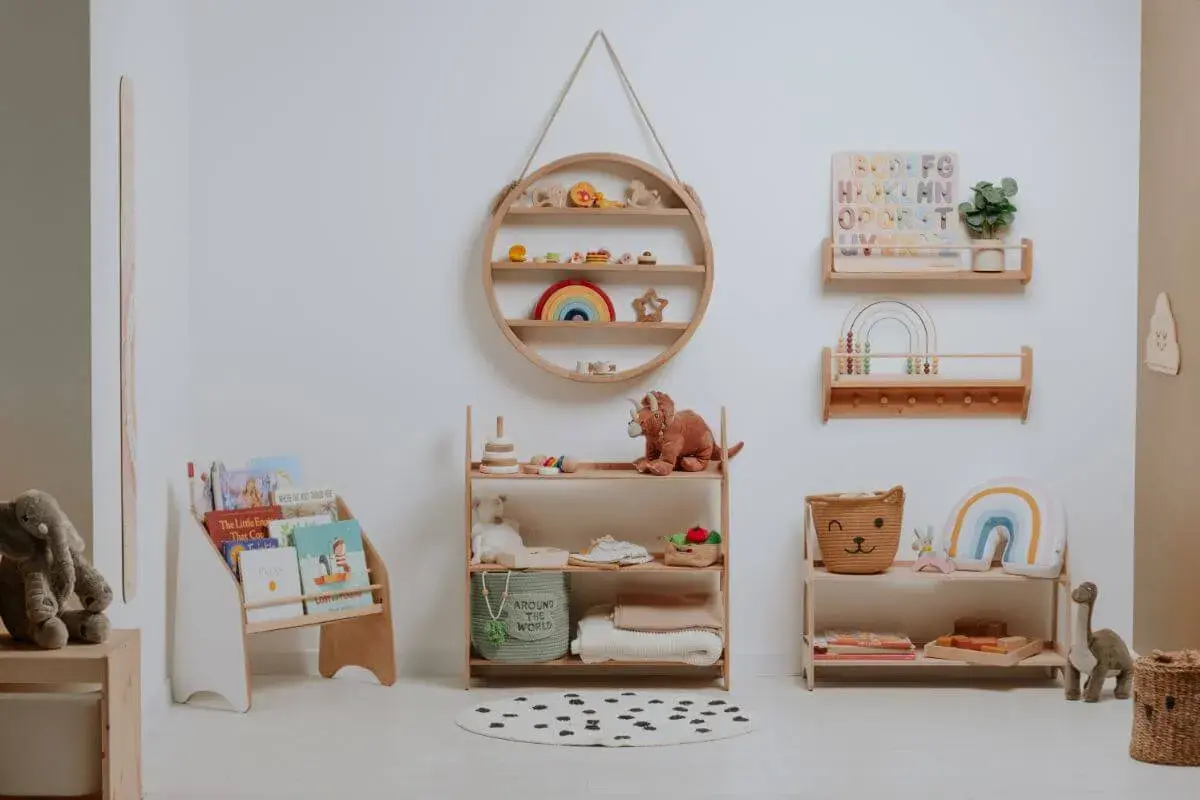
Montessori organization at home works best when the room is built around the child’s reach, rhythm, and attention span. In a nursery or playroom, that means fewer but better-chosen materials, clear places for everything, and a layout that makes it easy for a child to choose, use, and return what they have taken. I focus on the parts that actually change daily life: room zones, storage, toy rotation, safety, and the mistakes that make a space look tidy without becoming useful.
What a calm, child-led room actually needs
- Low open storage usually works better than deep bins or crowded toy walls because children can see and reach what they need.
- A nursery needs a quiet sleep area; a playroom needs a clear movement zone and an obvious cleanup path.
- For toddlers, I usually start with 6 to 8 visible activities, and even fewer for babies.
- Heavy furniture should be anchored, and heavier items belong on lower shelves where they cannot tempt climbing.
- Rotation should be slow, so the child keeps a sense of order instead of meeting a different room every day.
- Labels, trays, and baskets help only when the child can actually use them without adult help.
What a Montessori room needs to do
I usually start with the room’s job, not the decor. A nursery needs rest, feeding, and caregiving; a playroom needs movement, repetition, and a place where a child can keep returning to the same work. The Montessori goal is independence with order, not a perfect showroom.
That means the child should be able to see the materials, reach them without adult help, and put them back without a complicated cleanup ritual. Low shelves, simple baskets, and one purpose per zone make that possible. When the environment is clear, children spend less energy figuring out where things belong and more energy actually using them.
Once the purpose is obvious, the layout choices become much easier, which is why I like to map the room before I buy a single bin.

How to zone a nursery and a playroom without wasting space
I think of the room in zones, even if the room is small. A corner can be for sleep, one wall for access, one area for reading, and one clear patch of floor for movement. If the nursery and playroom share one space, I protect the quietest function first and let the rest of the room support it.
| Zone | What it should do | What I put there | What I avoid |
|---|---|---|---|
| Sleep area | Keep the room calm and support rest | Crib or bassinet, fitted sheet, dim lighting, minimal visual noise | Toys in the sleep space, bright clutter, oversized decor |
| Care area | Make dressing and diaper changes efficient | Diapers, wipes, clothes, lotions, and a hamper grouped in one place | Supplies spread across multiple drawers or rooms |
| Movement area | Give the child room for floor play and gross motor development | Mat or rug, clear floor space, safe low climbing support for older toddlers | Bulky toy bins, trip hazards, furniture crowding the floor |
| Reading corner | Invite quiet repetition and independent book choice | A small basket of books, cushion, soft light | An overstuffed shelf packed too tightly to browse |
| Activity shelf | Make choice and cleanup obvious | Trays, baskets, puzzles, simple art materials, and a small rotation set | Too many open-ended options at once or mixed materials with no home |
If you can describe each zone in one sentence, the room is probably working. Next comes the part that makes or breaks daily use: storage and furniture that children can actually handle.
Furniture and storage that support independence
I prefer to think in terms of access, not aesthetics. A low open shelf is useful because it turns the room into a place the child can read with their hands. A basket is useful because it is light enough to carry. A tray is useful because it gives one activity a boundary. Those are small details, but they change how the room feels in use.
For most nursery and playroom setups, I want a few basic pieces before anything else:
- A sturdy low shelf with open fronts so the child can see what is available.
- Small baskets or trays that hold one activity each, instead of dumping everything together.
- A child-sized chair or table only when the child is ready to use it for work, art, or snacks.
- Simple hooks or a low wardrobe space for clothing, dress-up, or bags that the child manages independently.
- A washable rug or mat that visually marks the movement area and keeps the room from feeling scattered.
- Labels with words or pictures when another caregiver needs the setup to be obvious at a glance.
I also treat wall-anchoring as non-negotiable. CPSC advises anchoring bookcases, dressers, shelves, and similar furniture to the wall, and that matters even more in a room where toddlers climb, pull, and test boundaries. The safest Montessori room is the one that cannot be turned upside down by curiosity.
Once the furniture works with the child instead of against them, the next question is what should actually sit on those shelves.
What belongs on the shelves and what should stay in rotation
This is where many rooms drift off track. People buy storage before they decide what deserves the storage. I usually start by grouping materials by type or age, then I keep the visible selection small enough that the child can understand it at a glance. If the room is packed, the child is not learning choice. They are learning overload.
For babies, I keep the shelf even simpler. A floor mat, a few grasping materials, a board-book basket, and one or two sensory objects are usually enough. Babies need repetition and stable reference points more than variety.
For toddlers, I use a slightly broader mix, but I still keep it manageable. Six to eight visible activities is a practical starting point in many homes, and I rotate slowly so the child has time to settle into the materials. If I change everything at once, I lose the very order the room is supposed to provide.
These are the kinds of items that tend to work well in a nursery or playroom:
- Simple puzzles with clear completion points.
- Open-ended materials such as blocks or nesting items.
- Practical life trays, like pouring, spooning, or sorting for older toddlers.
- A small art basket with crayons, paper, and one contained work surface.
- Book baskets with a limited number of covers visible at once.
- Sensory objects or soft materials that invite careful handling rather than noisy overstimulation.
I also like to involve older toddlers in rotation. If they ask for something new, I ask what they are ready to put away first. That small trade teaches ownership and keeps the room from becoming an adult-managed display. The more the child helps maintain the system, the more the system starts to last.
With the shelves under control, the final layer is making sure the room is safe enough to stay calm in real life, not just in a photo.
Safety is part of the setup, not an add-on
This is the section people often treat as optional, but in a nursery it should shape the design from the start. The AAP recommends a firm, flat sleep surface for infants, with no loose blankets, pillows, stuffed toys, or other soft items in the sleep space. In practice, that means the nursery should feel clean and minimal around the crib or bassinet, not overloaded with decoration.
I also look for the everyday hazards that interrupt a Montessori room fast:
- Anchor tall furniture to the wall.
- Keep heavy objects on lower shelves.
- Store cords, chargers, and lamps out of reach.
- Avoid placing tempting climb targets near shelves or dressers.
- Use non-slip pads under rugs so movement stays safe.
A beautiful nursery that is unsafe is not Montessori. It is just styled. The room should feel calm because it is orderly and secure, not because it is too delicate to be used.
Once safety is covered, the room can stay calm without becoming fragile. The next problem is the one almost every family runs into: the system slowly drifting back into clutter.
Common mistakes that make the room harder to use
The biggest mistake I see is overfilling the room and then hoping containers will solve the problem. Containers do not create order by themselves. They only hide the lack of a decision.
These are the patterns I would avoid:
- Too many choices on display, which makes cleanup harder and attention weaker.
- Storage that adults can use but children cannot, which turns the room into a parent project instead of a child environment.
- Changing the whole room too often, which removes the child’s sense of orientation.
- Pretty bins without clear categories, which look calm but are annoying to maintain.
- No cleanup path, meaning the child has nowhere obvious to return materials.
- Letting the room do everything, instead of giving each zone one clear purpose.
I would rather see one plain shelf that gets used every day than three polished shelves that nobody touches. The room should serve the child’s work, not compete with it. That is the simplest test I use when I decide whether a setup is actually Montessori or just visually tidy.
With those mistakes out of the way, the final step is choosing a starter setup that does not require a full overhaul.
The smallest setup that still feels complete
If I were setting up a nursery or playroom from scratch, I would start with just a few non-negotiables: one low shelf, one clear floor space, one book basket, one tray system, and one storage plan for items that are not currently in use. Then I would add only what the child can genuinely use.
- Clear one shelf and give every item a visible home.
- Place 6 to 8 activities on display, fewer if the child is younger or easily overwhelmed.
- Leave open floor space for movement and repeated play.
- Anchor tall furniture before adding anything decorative.
- Keep a rotation basket nearby so out-of-use materials have a place to go.
- Review the room weekly, not constantly, and remove anything that is no longer being used.
That kind of setup is usually enough to turn a nursery or playroom from visually busy into genuinely usable. The goal is not to freeze the room in perfect order, but to make it easy for a child to live in it, return to it, and gradually take more ownership of it.
