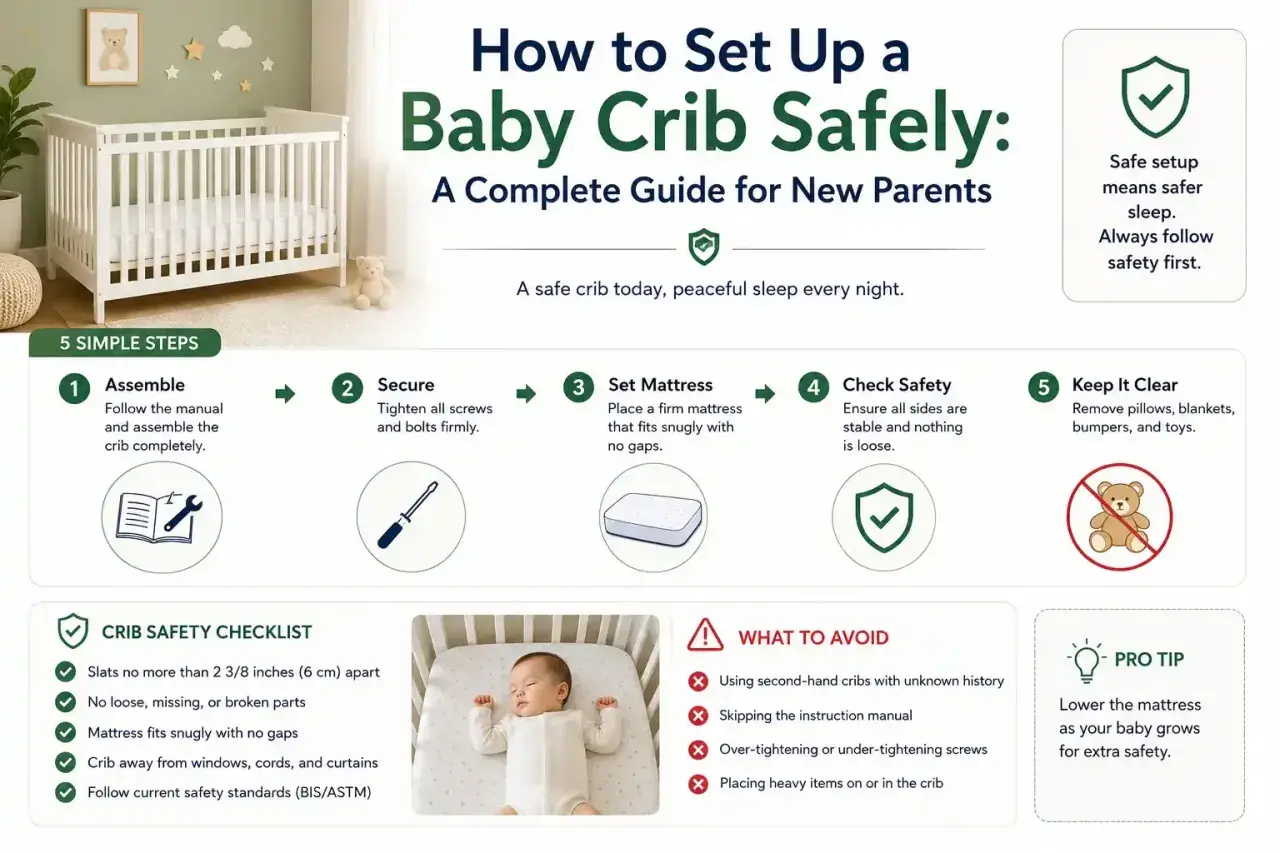
A crib is the main sleep space many families build the nursery around: a sturdy, enclosed baby bed with a firm mattress and sides that help keep sleep contained and predictable. The details matter as much as the definition, because crib design, mattress fit, and setup all affect safety, comfort, and how long the furniture will actually stay useful. I’ll break down what a crib is, which styles make sense in U.S. homes, the safety rules that really matter, and when it is time to move on to a toddler bed.
The crib itself is simple, but the setup decides whether it works well
- A crib is a baby bed with enclosed sides, a firm mattress, and a sleep area designed for infants.
- In the U.S., full-size cribs, mini cribs, portable cribs, and convertible cribs each solve a different space problem.
- Safe sleep means a bare crib: fitted sheet only, no pillows, quilts, bumpers, or loose toys.
- Climbing out is the clearest sign that crib time is ending, even if your child is still young.
- Buying for fit and safety first usually matters more than buying the fanciest design.
What a crib is and how it differs from other baby sleep spaces
I usually think of a crib as the nursery’s long-term sleep base. It is bigger and more durable than a bassinet, more contained than a toddler bed, and built to hold up through months or years of daily use. In the United States, the standard full-size crib is defined by federal dimensions, while smaller versions exist for tighter rooms, travel, or shorter-term use.
| Sleep space | Best for | Main advantage | Main limit |
|---|---|---|---|
| Bassinet | Newborns in the first months | Small footprint and easy bedside placement | Short use window |
| Crib | Infants and toddlers | Longest standard nursery solution | Takes more room |
| Toddler bed | Children ready to leave the crib | More independence for a growing child | Less containment at night |
That comparison is the simplest way to see the crib’s role. It is the middle ground: long-lasting enough to be practical, but still built to keep a baby in a protected sleep space. Once that definition is clear, the next question is which crib style actually fits the room and the family’s timeline.
The crib styles that matter most in U.S. nurseries
Not every crib serves the same purpose. The Consumer Product Safety Commission separates full-size and non-full-size models, and that distinction matters because size, mobility, and mattress compatibility change how you will live with the crib day to day. I look at crib style as a practical choice, not just a design choice.| Crib type | Why families choose it | What to watch for |
|---|---|---|
| Full-size crib | Best long-term value for a standard nursery | Needs more room and a mattress made for that exact crib |
| Mini crib | Useful for small bedrooms or apartments | Usually outgrown sooner than a full-size crib |
| Portable crib | Good for travel, grandparents’ homes, or flexible sleeping | Check weight limits and folding hardware carefully |
| Convertible crib | Can turn into a toddler bed or full-size bed later | Only worth it if the conversion parts are solid and actually available |
I like convertible cribs when a family truly plans to use the later stages. If the conversion is never going to happen, you may be paying extra for hardware and promises you do not need. For a small nursery, a mini crib can be the smarter answer, but the tradeoff is simple: less footprint now, less runway later.

What makes a crib safe for sleep
This is the part I treat as non-negotiable. The U.S. Consumer Product Safety Commission expects modern cribs to meet strict rules, including tight slat spacing and secure construction, and the American Academy of Pediatrics is equally direct about safe sleep: keep the crib bare, place the baby on the back, and do not add soft extras that raise the risk of suffocation or entrapment.
- Use a firm, tight-fitting mattress designed for the specific crib.
- Make sure hardware is secure, with no missing, loose, or broken parts.
- Check that slats are no more than 2 3/8 inches apart.
- Avoid any crib with a drop-side rail.
- Keep the sleep space bare except for a fitted sheet.
- Skip bumpers, pillows, quilts, comforters, and stuffed toys.
- Check recall status before using an older or secondhand crib.
If a crib has missing instructions, damaged hardware, or a mattress that does not fit tightly, I would not use it. That is where the difference between a cute nursery item and a genuinely safe sleep product becomes obvious. Once the crib is safe, the next question is when it stops being the right fit.
When a crib stops being the right fit
There is no magic birthday for leaving the crib. In practice, many children move sometime between about 18 months and 3 years, but the stronger signal is behavior and safety, not a calendar date. Once a child can climb out, the crib is no longer doing its job, and the risk of a fall usually outweighs the comfort of keeping the setup unchanged.
- Your child starts climbing or trying to climb out.
- The crib no longer contains them safely because of height or mobility.
- Bedtime turns into repeated escape attempts.
- You need the crib for a new baby and want to transition early.
- Your child has clearly outgrown the space the crib gives them.
Some families move straight to a twin bed with a guardrail, while others prefer a toddler bed because it sits lower and feels less abrupt. I care less about the label than about the safety result: the new sleep space should reduce fall risk, not create a new one. Once you know when the crib phase is ending, the purchase decision becomes much easier.
How to choose a crib that will still make sense six months from now
When I help someone choose a crib, I look at five things before I look at style: fit, safety, room size, future use, and how easy it will be to live with. A beautiful crib that barely fits through the doorway or uses a mattress you cannot replace cleanly is not a great buy, even if it looks perfect in photos.
- Measure the nursery, the doorway, and the space around the crib before buying.
- Match the mattress to the exact crib model instead of guessing by size alone.
- Decide early whether a convertible crib will really be used later.
- Buy new if possible, especially if you want the cleanest path to current safety standards.
- If you buy used, verify the model, hardware, instructions, and recall status.
- Look for fixed sides and solid construction instead of decorative features that do not help sleep.
The small details that keep a nursery calm after day one
The best crib setup is usually the least dramatic one. Keep the sleep space clear, use only the fitted sheet that belongs there, and place the crib where cords, blinds, and other hazards are not within reach. I also like parents to save the manual and spare hardware in one place, because those little pieces matter if the crib ever gets moved, stored, or converted.
- Keep the crib away from window cords and hanging blinds.
- Use the exact mattress the crib was designed for.
- Skip decorative bedding until your child is old enough for it to be safe.
- Store the instructions and extra hardware together.
- Think ahead about the move to a bed before climbing becomes an emergency.
For most families, a crib is not just a small bed. It is the anchor of the first sleep routine, and it works best when the definition, the safety rules, and the transition plan all line up. Get those details right, and the crib does what it should do quietly: give your baby a safe place to sleep and give you one less thing to worry about at night.
