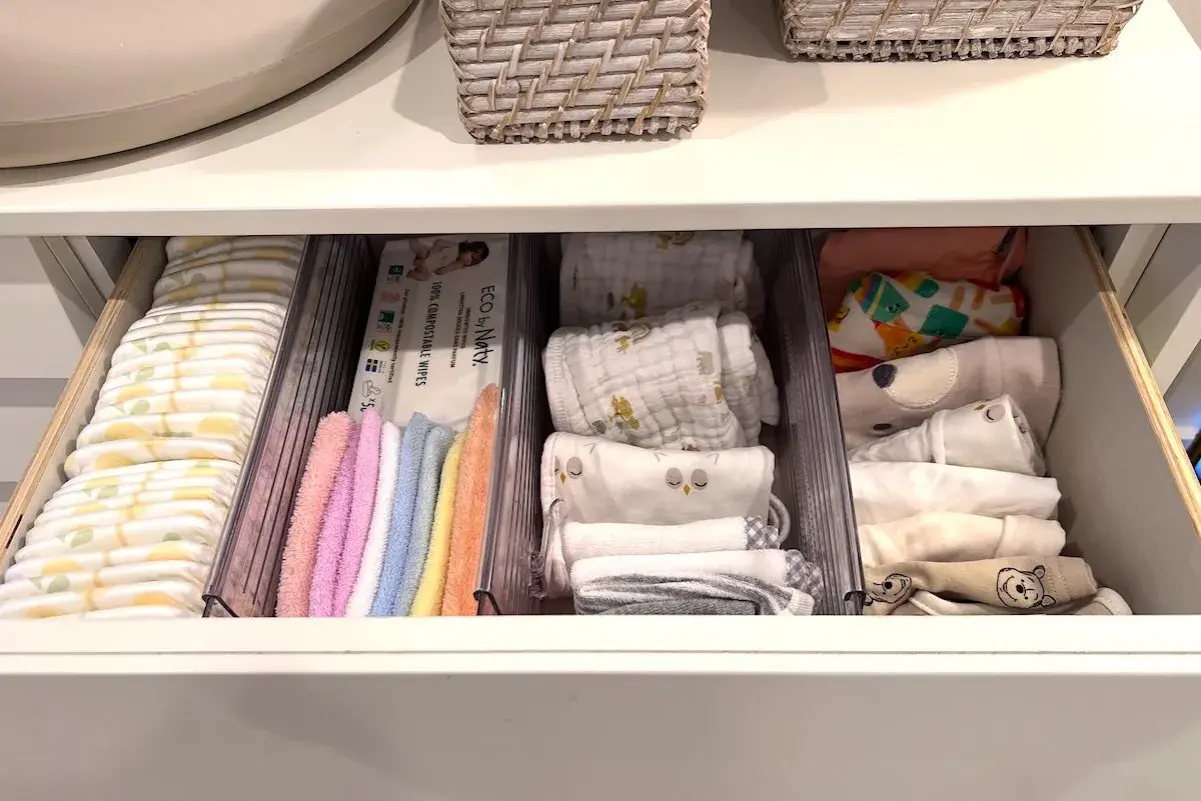
When I think about how to organize baby stuff, I start with one rule: give every item a place based on how often you use it, not just what it is. That keeps diapers, clothes, toys, and backup gear from fighting for the same drawers, and it makes the nursery easier to reset after a busy day.
The simplest baby storage plan is the one you can reset in minutes
- Sort items by frequency of use first: daily, weekly, backup, and outgrown.
- Keep diapering and dressing supplies closest to the changing area.
- Use drawers for small items, open bins for toys, and vertical storage for overflow.
- Keep the crib empty and anchor tall furniture to the wall.
- Build in a weekly 15-minute reset so clutter does not come back.
Start with a sorting system that matches real use
I like to begin by separating baby items into four groups: things you use several times a day, things you use weekly, things you are storing as backup, and things the baby has outgrown. That first pass matters because a nursery fails when everything is treated as equally urgent. A pacifier, a spare swaddle, and next-size pajamas do not belong in the same storage zone.
Here is the simplest way I break it down:
| Group | Where it should live | Examples |
|---|---|---|
| Daily use | Top drawers, caddies, or open bins near the changing area | Diapers, wipes, rash cream, burp cloths, onesies |
| Weekly use | Lower drawers, closet shelves, or labeled baskets | Sleep sacks, extra blankets, bath towels, extra sheets |
| Backup items | Closet shelves or a dedicated overflow bin | Next-size clothing, unopened formula, spare pacifier packs |
| Outgrown items | Labeled storage box outside the nursery | Clothes to donate, keepsakes, items for the next child |
That structure keeps the room from becoming a catch-all. Once the categories are clear, the changing station becomes much easier to plan.
Make the changing station the center of the room
If I had to prioritize one area, it would be the changing station. It is the place where the most frequent interruptions happen, so it should hold the items you reach for without thinking. A dresser with a changing pad on top usually works better than a separate changing table because it gives you storage long after the diaper stage ends.
A practical starter setup in the US often falls into two budget bands: $40 to $80 if you already have furniture and only need bins, dividers, and a changing pad, or roughly $150 to $500 if you are buying a new dresser and organizing pieces at the same time. I usually tell parents to spend first on function, then on looks.
What belongs in the top drawers
- Diapers in the current size.
- Wipes and diaper cream.
- Spare onesies, sleepers, and socks.
- Burp cloths and washcloths.
What belongs in the lower drawers
- Next-size clothes.
- Sleep sacks and blankets that are not in daily rotation.
- Extra crib sheets.
- Seasonal items like hats, mittens, or heavier layers.
I also like drawer dividers here because baby clothes are small enough to tangle into one messy pile fast. A divider for socks, one for bodysuits, and one for sleepwear saves real time, especially when you are dressing a half-asleep baby. From there, the next move is to use the closet and wall space without overcrowding the nursery.
Use the closet and walls for the overflow
The closet is where a lot of good nursery organization plans either succeed or collapse. Baby clothes do not need long hanging space, so I prefer to use the lower half of the closet for stackable drawers, cube shelves, or labeled bins. That gives you a place for backup clothes, blankets, and supplies without letting the room fill with loose piles.
| Storage option | Best for | Typical cost in the US | What to watch for |
|---|---|---|---|
| Dresser drawers | Clothes, sleepwear, linens | $100 to $400 | Deep drawers are better than shallow ones for baby gear. |
| Fabric or plastic bins | Socks, hats, lotion, small accessories | $10 to $30 per set | Choose labels that are easy to read and replace. |
| Cube shelf with bins | Toys, blankets, bulkier backup items | $40 to $150 | Anchor tall pieces to the wall. |
| Over-the-door organizer | Pacifiers, shoes, bibs, tiny supplies | $15 to $35 | Works best when the pockets are clear and shallow. |
| Wall hooks and rails | Receiving blankets, bags, hats, lightweight gear | $10 to $25 | Keep anything heavy off the wall hooks. |
Open storage helps when you need to see what you have, but it only works if the containers are simple enough to put away quickly. If the bin takes more than a few seconds to reset, it will not stay organized for long. That is why I usually prefer a small number of clear systems over a room full of clever ones.
Once the closet is doing the heavy lifting, the playroom needs its own setup so cleanup stays fast instead of becoming a second job.
Set up the playroom so cleanup takes less than two minutes
In the playroom, the goal is not to display every toy at once. The goal is to make it easy for a child to find, play, and put away what is out. I like open bins for large categories and a low shelf for books because both invite independent cleanup without turning the room into visual noise.
What works well in a baby or toddler play space
- One bin for stuffed animals.
- One bin for blocks or stacking toys.
- One bin for board books.
- One bin for loose parts like rattles, teethers, or small play sets.
Read Also: Montessori Garden - Create a Child-Led Outdoor Space
What usually creates clutter
- Too many mixed toys in one deep basket.
- Decorative storage that looks good but is annoying to use.
- Big toy collections left in circulation all at once.
- Book storage that hides covers instead of showing them.
My experience is that toy rotation helps more than almost any fancy organizer. Keep a smaller visible set in play and store the rest elsewhere, then swap items every week or two. That keeps interest up without turning the playroom into a constant sorting project. From there, the last piece is making sure the storage plan is safe as well as tidy.
Keep safety built into the storage plan
Organizing baby items is not just about convenience. It also affects safety, especially in sleep and storage zones. The American Academy of Pediatrics recommends a crib that stays empty except for a fitted sheet, which means no pillows, loose blankets, stuffed toys, or padded accessories in the sleep space. That rule matters even when the room feels unfinished.
The same logic applies to furniture. The CPSC recommends anchoring dressers, bookcases, and other freestanding pieces to the wall to reduce tip-over risk, and I treat that as non-negotiable in any nursery or playroom. Heavy storage should stay low, cords should stay out of reach, and nothing bulky should be hung on the crib rails.
- Keep the crib free of soft items and loose bedding.
- Anchor tall furniture to studs or use a proper wall-anchoring kit.
- Store diapers, creams, and medicines out of a child’s reach.
- Do not place bins, baskets, or wall decor where a child can pull them down.
- Check used furniture for recalls and stability before bringing it into the room.
Safety does not have to make the room feel sterile. It just means the storage plan should be calm, sturdy, and boring in the best possible way. Once that is in place, the only thing left is maintenance.
The weekly reset that keeps the nursery from drifting back into chaos
I recommend a short reset once a week, usually 15 minutes at most. That is enough time to pull out outgrown clothes, refill diaper supplies, move toys back to their bins, and check whether any storage has become overloaded. Small resets are easier to keep than a massive monthly cleanup, and they stop clutter before it spreads.
- Move outgrown clothes into a donation or storage box.
- Refill diapers, wipes, and rash cream.
- Return books and toys to their labeled bins.
- Wash and restock blankets, sleep sacks, and crib sheets.
- Check whether any drawer or shelf needs a label update.
If you build the room around daily use, keep overflow in labeled zones, and leave enough empty space for the next stage, the whole system gets easier instead of harder. That is the real answer to a nursery that works now and still makes sense after the baby grows into toddler life.
